


Our Influential Storytelling Class
Last week we re-launched our Influential Storytelling class. Like all good motors, it needed a tune up, and just in time too. These 15 participants came together from 7 different organizations to get down to the business of “story.”
One of the attendees in his evaluation said:
“It is rare that one experiences something that could truly change the way they behave. I like to tell stories but often feel that I give way too much info in the beginning and never get to the point. The idea of “architecting” stories is powerful AND I plan to use it.”
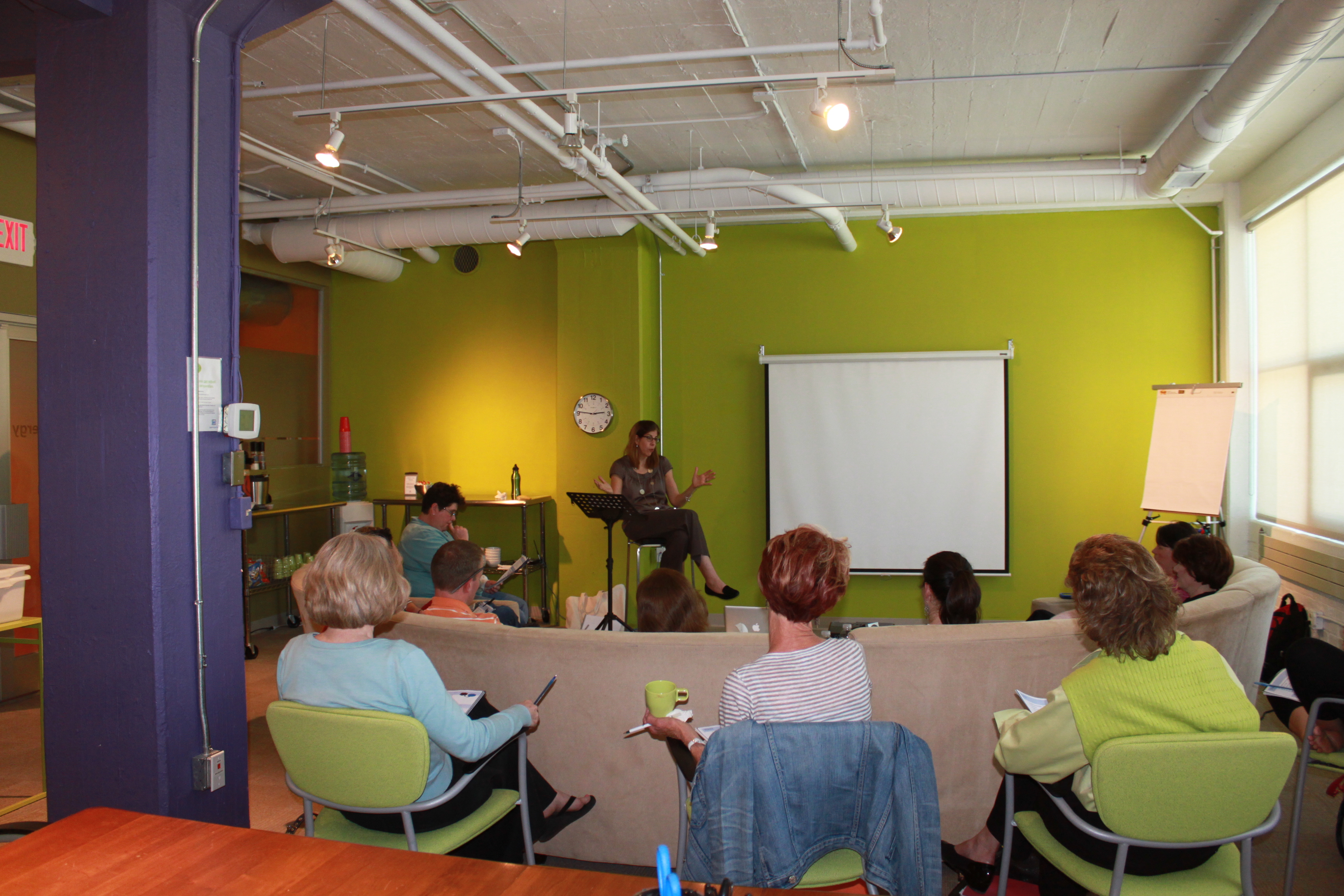
The workshop weaves blending of learnings we’ve had over the years between our critical thinking class, our four years of experience with TED and TEDx, our every day coaching of a wide range of speakers and our own pen-to-paper discipline of helping to write a major keynote address at least once a month. If we have a headline show right now in our toolkit of learning, this would be it.
Who needs this class?
Last week, the day after our class, I visited with a CEO of a major financial services firm. She recounted a situation where one of her top financial analysts had been meeting with their executive team for 8 weeks to review some trending data about a big part of their financial situation (I wish I could tell you what part but clearly it was sensitive and confidential). For 8 weeks during these meetings, she said they smiled and nodded, then politely put the charts and graphs in their folders each week, pretending to understand. It wasn’t until week 9 when the analyst came to the meeting with the following metaphor: “Let me explain that this situation I’ve been trying to paint for you is like cutting off the oxygen to our respiratory system. We are literally running out of breath.” She said it wasn’t until he related it to something she understood – the critical nature of breathing – that she finally “got it.”
Albeit a few weeks late, that is a well told story. Both the CEO and the analyst would have been well served to understand the power that a simple metaphor can bring – and how and when to use them. They also would have been well served to be able to coach each other on other effective storytelling tools – bottomlining, changing a point of view and a clear, concise message to list a few.
If you are having a hard time getting your critical messages across and evoking the behavior you seek to change, may we suggest a little dose of storytelling may just go a long way.
No Comments
The Value of ‘Values in Action’ Stories
So I guess if you don’t have company values, it would be hard to tell any “values in action” stories about them. But the reality is, we all drive our businesses on a set of SOME values – and we behave consistent with them every day. Harvesting those stories that best demonstrate how you live out your values needs to be an intentional effort, however, so they can be shared and passed around — building trust, resilience, reputation and maintaining a vision.
At the 2012 Annual Meeting of the Greater Columbus Chamber of Commerce, resource interactive Founder Nancy Kramer gave a resonating and lively speech reflecting on her company’s values and how they positioned resource for sustainable growth. We were fortunate to have the opportunity to partner with her on this talk, which, as you can tell if you watch through to the end, made it one memorable event.
Once you are done watching the talk, see if you can repeat back the stories she uses to demonstrate their values.
1 CommentGet your story on
My favorite quote from the TED Conference this year was from the (now former) head of DARPA, the defense agency that plans our strategic responses on surprise attacks, Regina Dugan. She said: “If you want to learn to fly, you have to FLY.”
It seemed so simple. But for an agency that fails all the time in its experiments, it meant so much.
I used the quote this week as I prepared to conduct a webinar on using stories in virutal relationships: if you want to build the relationship, you have to share stories. Nothing else achieves the same result. Simple, but hard.
So my tip for the month is: if you want your stories to be impactful, start telling stories.
Storytelling Workshop: Special Session
So maybe you are wondering how do I tell those impactful stories? We’ve opened up a one day workshop on Influential Storytelling on April 19 from 9am – 3pm (in Columbus) to help. It’s a small group and we’re almost at capacity, so click here if you’d like to join us. We normally only do these workshops inside corporations – we are excited to be able to offer this session for anyone that wants to attend.
A little more TEDx – related news:
– Next week on April 5, we are hosting TEDxChange, a 90 minute program being broadcast from Berlin, featuring Melinda Gates and other speakers on crticial worldwide issues. Registration is free, an optional lunch can be ordered. Click here.
– We have opened nominations for the fall TEDxColumbus event on October 5 @ COSI, click here to read our blog for details. This year’s theme is “The Future Revealed.”
– We have started a new initative called Readers’ Roundtable. Inspired by their respective TEDxColumbus talk, each session will be lead by a former TEDxColumbus speaker who chooses a book and facilities discussion. Learn more and register for an event.
– Lastly, we encourage you to watch Bryan Stevenson’s talk. His talk was among the most favored at TED this year, and with good reasons. Beyond his compelling argument, just listen to his stories.
A Closing Memorial
I will close with a little honor to my big and very special dad who passed away unexpectedly but very peacefully on March 3. For those of you that know me know what an inspiration and influence he was on my life, especially as a great orator and storyteller. I was honored to give a eulogy at his funeral, my greatest challenge I’ve ever experienced as a public speaker. Good news is that he left a litany of rich stories for me to share. May he rest in peace.
No CommentsThink you can
When I asked a client recently why she was nervous heading into a big talk, one of her first replies was “I beat myself up for the last bad talk I gave.”
Speaking when your medium isn’t language.
On the TEDxColumbus stage over the last three years, we’ve had a variety of performance artists: musicians, poets and such. This post is not about them.
It is about those individuals who have a medium other than their own voice, movement or acting to express their artistry (design, painting). I turned to wikipedia for a definition: An artist also may be defined unofficially as “a person who expresses him- or herself through a medium.”
But what happens when you ask an artist to communicate their thoughts in another manner – most commonly, language (written or spoken) – that also has critiques, deadlines, a huge audience and permenant record through video?
My hypotheses is that when an artist whose medium is not language is forced to communicate his/her work through language (spoken or written) the process is troubling.
So something oddly coincidental happened within the 12 hours before our TEDxColumbus 2011 event. Of the 18 speakers and performers, 3 of them attempted to impose changes to their slides within 12 hours before the program began. And by all accounts, they were the three artists of the group who were going to speak.
They otherwise distinguished themselves by a few screaming characteristics. And the fact is, I’ve had several other clients and TEDx speakers who have exhibited the same behavior. But it wasn’t until I saw them side by side within 24 hours did I finally get it.
The characteristics were:
– The process of preparing a talk was torturous. Having to meet any deadline, having to go through any edit or review, having to had the talk DONE before the talk itself was simply a life-altering experience. And not always a good one.
– Their topics kept evolving. Sure, they were generally in the same realm of the idea they originally proposed discussing, but the end result was fairly far distant from where we started. Imagine someone saying to you: “I’m going to be a devil for Halloween” and they turn up on stage looking like an angel. That might be great for Halloween but not a TEDx talk.
– To the aforementioned point, they never finished their talk so therefore they didn’t really practice it. And when they showed up to rehearsal, they were still in an edit mode. And the next day, another edit. And really, through their sleep the night before the event, another.
– In hindsight, they wanted to talk about a different topic altogether. Everyone wants to give a different talk after they’ve given one, that’s pretty common. But these folks wanted to pick a different topic.
Earlier this year, I had the pleasure of working with another local artist in preparing for a book tour. When we were done working on her talk, she said she thought she needed a second talk. The creative genius in her didn’t want to be done.
I am placing no judgment on the way these colleagues of mine navigate the pathway of getting on the stage to make remarks. I’m simply suggesting, if you are one of these people, please remember that the best talks benefit from rehearsals and practice. And if you are in a constant state of revision, then the talk never quite is done and well, probably is never really practiced.
Be okay with a moment, just a moment, of ‘done.’ There will be plenty more revisions to make to artwork, drawings, concepts and plans that don’t involve an audience trying to follow – or subsequently share – your ideas.
2 Comments
Tools of the trade
Rose Smith, during her highly provocative poetry performance at TEDxColumbus, challenged us all to betools. You know, as in a conduit for helping others, making change or doing good.
While my tip this month isn’t as deep, her challenge made me think about the tools that the speakers used during TEDxColumbus in their variety of preparation pathways (and let me tell you, there was some variety!). So, if you are making your list for Santa, here’s a few things to consider:
– A whiteboard. Map out your talk to see the main buckets of information or how it will flow. When you get away from your computer, the logic of your talk can have more meaning. Claudia Kirsch and I spent an afternoon shaping her sequence on a whiteboard which became a major point of clarity in refining her key messages.
– Your own personal clicker (yes, you can own one too). So that when your slides are done, you can practice working on transitions so that your verbal – vocal and visual messages align. We lent ours to Maryanna Klatt to practice with her slides, she said it made the world of difference. (Here are a few options of where to get one.)
– A recording device. The analog version would be a tape recorder, the digital might be voicememos on your iPhone or iPad. Theresa Flores used this extensively in her practice, whereby keeping the story in her head (and off of a script, the computer or notes) and making immediate improvements to her pace, sequence and influctions.
– Time. Give yourself the gift of some more days or hours to prepare. Bart Overly said he spent 100 hours preparing this talk (take a look at his slides and you’ll know why), Alex Bandar spent between 30-40, a more typical expenditure. Either one of them will tell you the time helped them be as prepared for their talks as any they’ve given.
While you may not be giving a TED/TEDx talk anytime soon, chances are one of these tools might come in handy for your next talk wherever it may be.
No CommentsIt’s my turn for the stage
This week I’ll be speaking at the Cityworks (X)po in Roanoke, Virginia. I was invited to speak on behalf of the TEDx global community, which now equates to 3417 events in 117 countries. Humbled, yes. Nervous, no. Since this is my “TEDx” season, the content is omnipresent in the brain, especially thanks to a great hour-long talk show with our leading local radio host.
For those of you curious about my preparation runway for a major talk, here are my 5 steps. These aren’t for everyone, but they work for me.
- Research on everything. Audience, venue, potential facts to include, reading trends, other related videos. Then let simmer.
- Work on governing idea – what’s the one thing I’ll leave them with? Develop no more than 3 key buckets of support. Brainstorm stories to resonate the buckets.
- Talk it through on my voice memos app. Transcribe it. Reverse engineer the outline to revise number two.
- Talk it through again, and make a list of visual imagery I need to resonate the stories. Research, download, buy or borrow visuals.
- Practice, syndicate and practice again. Make a note card with outline as backup.
One Client’s Pathway to Resonance
Everyone has their own preparation path toward great speaking, we’re thrilled to see what changes our clients have made in theirs.
One of our clients shared with me in an email that her speaking style had improved so much after her sessions with us. I asked her for what strategies were helping HER the most. Her response:
“In the past sometimes I would just wing it. I would know the topic and would just go for it. This new way I am ready to speak on every slide, I know it cold. They could do the slides backward and I could do it. I can also tell you exactly how long my program will be.
The other thing is the stories. I told stories in the past but did not place them in certain places on purpose – for example the story at the start to get their attention and why this program is something “they” need to hear…
I have also changed how I am introduced. I never liked for people to hear all that info about me. So I am much more comfortable with a short intro that tells them why they should listent to me.
The other thing I am doing different is I used to be a walker and now I stay behind the stand and it keeps me focused and helps me to look around the room in a more controlled uniform matter.”
No CommentsThe problem with the panel.
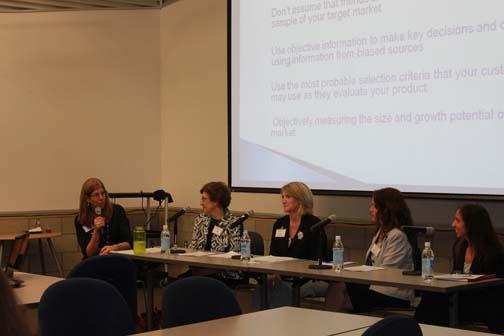
TECHColumbus Marketing Technology Panel. September 7, 2011
Let me thank the panelists from last week’s Women and Marketing event at TECHColumbus: Joan Manter, Nancy Bohman, Amy Marshall and Padma Sastry. I won’t repeat the content of the panel discussion since Nancy has a wonderful recap on her blog.
But what I do want to explore for a moment is the notion of the panel as a presentation format.
Yes, it may seem hypocritical that I’m in the photo above moderating last week’s panel and now want to question its veracity.
The reality is when I accepted the invitation, I insisted that we all gather to map out a ‘panel plan.’ And indeed, I made good on my promise and helped them wrestled a narrow topic presented in the form of five thought-provoking questions that each of us would answer. While unstated to the group, my goals in facilitating this plan were:
a. Do not have any replicating content, i.e., we each need to say something worthwhile and different;
b. Find a quality example (story, anecdote) to illuminate the ‘answers to the questions,’ i.e., give what we say a fighting chance to be remembered;
c. End on time, i.e. if we are remembered for anything, don’t make people blame us for being late to work.
So, interestingly enough, I believe the general goals from TECHColumbus in having the panel were to:
a. explore a topic that would attract an interesting group of women
b. showcase some industry experts on their turf
c. facilitate networking
All really noble goals.
But therein lies the problem with the panel, in general. It is not designed with the very broad audience in mind. At least the audience as a person listening to content. Trying to decide what is important. Who is credible. What they should take back to their desks and repeat to their colleagues. In between three cups of morning coffee. Rather, it is designed with the audience as a person who wants to network and be seen.
I visited Wikipedia a while ago on a whim looking for insight. My hypotheses was correct (for once). The “panel” was created as a listening tool, not a talking one. As in panel of judges, listening to a case.
You can see from Wikipedia’s list of purposes that a panel serves, none of them center on inviting a group of people who don’t know each other to sit together and talk to others who are there to listen. It is usually the other way around.
I asked someone at our local discussion forum which I admire greatly, Columbus Metropolitan Club, once, why do you have panels? And his candid response was: it helps to drive a crowd. If there are experts on the panel with whom people can affiliate, then there will be attendance. Fair enough.
But I’ll say it out loud. As an presentation format, I’m not a big fan of the panel. Tough for panelists to get connected, coordinated and in a good flow; tough for the audience to follow, comprehend and be impacted.
As a tool for resonating an idea, creating buzz, telling a true story, transferring knowledge or even evoking one emotion, don’t look to the panel.
As a tool to market your organization, gain some awareness, or as a vehicle for networking, sign it up.
No CommentsHow was your summer?
In our Influential Storytelling class at ar.tic.u.la.tion, we apply critical thinking methodologies to help properly frame a story. So on our summer family vacation a week ago, I thought I’d test the logic with my 7 year old daughter. What better story to practice than “what I did this summer,” knowing she’d be quizzed upon returning to school in a few days.
We found some post it notes at our cabin (lucky us) and brainstormed every memorable summer moment. After coming up with 40 points, I suggested we try to group them in 3 themes. We came up with four different grouping options:
One set were grouped by who participated in the moments with her and her brother – us, her sitter or others.
Another group was where they did them- at home, in town, or out of town.
A third was by old things, new things and things to repeat.
The last was by activity type – sitting down, standing up or in a pool!
Before you claim I’m a horrible parent for inflicting such a rigorous overlay to my daughter’s outstanding summer, she called uncle and stopped it as it was “boring.” And it was.
We hadn’t gotten to how to weave in the great visual support for any example – such as of learning to play tee ball, learning about Cleopatra in Cincinnati, building a train with her brother in the basement art space, or watching movies outdoors at the local park. For a seven year old, the fun was in the examples, not the story structure. Fair enough for a girl still on vacation.
The point is that she won’t have time or space to report all 40 activities when she answers the question. Ideally, she’d have a great narrative rooted in three general groups that revealed a supporting example- and illustrated succinctly why her summer was so awesome. Of course I don’t expect her (yet) to understand this, but by the time our official Storytelling Class closes each time, our clients certainly should.
So, tell me, how was your summer?
No Comments