


Is it Really a Presentation Problem?

The look I imagine these supervisors had before calling me with the "presentation problem."
These are calls I’ve gotten recently from clients, concerned about performances of some of their key women.
“She is fine when she’s one-on-one with colleagues, but as soon as she goes into a group meeting or presentation, she clams up. We know she has good communication skills, but she refuses to use them.”
“During the presentation, she didn’t read the room well. She’s done this talk many times and practiced it over and over. Just because a few people were unhappy with the direction, it must have thrown her off because she just kept talking. Someone in the pitch ultimately asked her to sit down in the middle of her unfinished deck.”
“I had a board member look at me and say, “You say they do good work (this internal team made of women), but wow their presentations are horrible. How could that be? – they are a communications team!”
“She has a great communication style and reports that she isn’t nervous, but every time she starts a presentation or even a conversation with a group – she begins to be blush. Her neck turns completely red for at least 15 minutes. How could that be so incongruent with what she’s feeling inside?”
“She answered a question of a board member that should have taken 1 sentence to complete. Instead she took 5 minutes to get it out. She knew the information, what happened?”
Five different industries. Five different situations. Five different women, ages, backgrounds. So what’s the connection?
Each of these calls came from a concerned supervisor. They wanted me to help coach these specific executives into better communication behaviors. You know, be concise. Answer the question asked. Speak up. Be clear. Be compelling. Be engaging.
But each of these executives had communication skills. Sure, we could work on a few improvements. But there was other work that had to be done first.
I’ll call it grounding.
My colleague Suzanne Roberts is the expert at this, and I’ll extrapolate what I’ve learned from her insightful and sustainable somatic coaching.
We each have history and experience that comes with us wherever we are. And if that history and those experiences have not been reconciled – they will rear their ugliness at times of pressure, stress and uncertainty. Like a consequential presentation.
We don’t feel grounded. Or maybe more exactly – we may have consciously convinced ourselves we are grounded – but subconsciously, we really aren’t. And then our “psycho-biology” kicks in. In short, our body works without the advent of self-control from our brain. The closed body stance. The flush neck. Ignoring other’s non-verbals. Over-talking.
So when I was talking to the supervisor of the woman who wouldn’t speak up. I asked a few basic questions because I suspected what Suzanne calls “secondary trauma.” Meaning, she wasn’t personally injured or hurt, but she was around someone who was. Or saw pain and suffering that impacted her. Indeed, her parents were divorced and she had a sister that died in her teens. But more importantly, she had a previous boss who gave her difficult feedback – harsh, rude, negative feedback. Not ever positive or developmental. In those meetings she’s feeling like she has a faultine she’s standing on. So she freezes. It’s safe there (really?). There’s no risk in freezing since you do nothing (your body says). Until your supervisor says your job is on the line if you don’t step up and contribute (yipes!).
Others may flee – avoid the situation. Others defend – talking too much – questioning themselves and their knowledge. And even others may fight back. Take a punch, blame the behavior on someone else. “They didn’t prepare me well for the situation I was about to enter.”
The woman that ignored the feedback? She was trained as a beauty queen as a youth. She didn’t know how to take feedback that wasn’t smiling and clapping, so that’s what she looked for. She ignored all other signs of not doing “perfect.” She had no recovery mechanism.
So as you evaluate, coach and monitor both yourself and your colleagues’ communication inefficiencies, be sure to dig a little deeper at the subconscious triggers that are informing behavior. Because like it or not, we carry all of our experiences with us and it take work to know how to have self-control to keep them from getting in the way of a great presentation.
Articulation Inc will be addressing these issues in concert with Unifying Solutions with a new workshop offering in Fall, 2014. Email ruth (at) articulationinc.com for more information.
No CommentsOn Coaching Speakers.
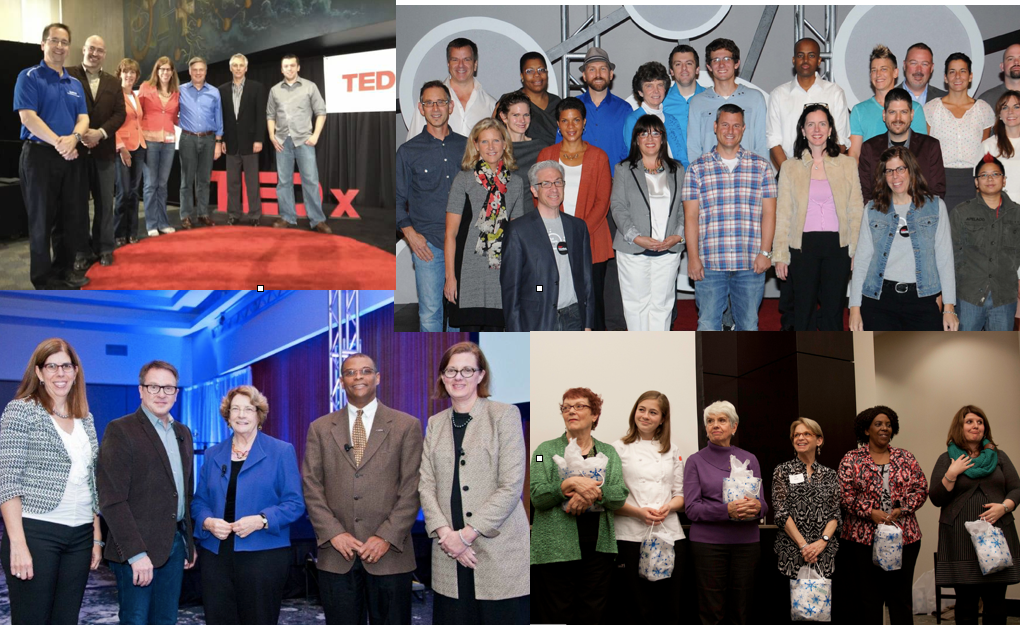
Some of the groups of speakers I coached in 2013.
This month I’ve been asked twice to orient / train / tell / brief people on how to coach speakers inside their companies. I’ve struggled with responding as I never like to say no, but in this case, it’s the only answer. I came to appreciate that I haven’t clearly articulated (pun intended) why I coach, how I coach and why I’m not ready to train others to do so – yet.
So let’s start here: I LOVE to coach speakers. It is my happy place, sweet spot and I’m in a professional nirvana when I get to do it. I was a speech communication major in college, I was a speechwriter for five or so years out of college, and my favorite moments since then have been when I’ve helped my associates and clients find their voice and tell their story. I also watch graduation speeches for fun demonstrating that I’m a true geek about it all.
That’s why I love to coach speakers. It’s who I am.
When I started to think about how WOULD I tell a client how to coach their own speakers, I started getting a pit in my stomach, clammy hands and a lump in my throat. Was it because I didn’t want to give up trade secrets? Or that I don’t want to give up the special relationship I get to have with every speaker – listening to vulnerabilities, coaching to strengths, celebrating the standing ovation. Maybe.
But as a professional communication trainer as well, I truly appreciate the diligence and discipline in developing the right curriculum for training someone to learn a new craft, like being a coach to speakers. Giving someone some basic feedback on how they delivered a talk that someone else wrote is one thing (i.e. look at the audience, talk slower, don’t pace). But taking that same person on a journey from not knowing what they are going to talk about, to developing a talk, supporting stories, working through the messes of revisions, getting them to practice and rehearse and at the end of it all – not letting them have a single note and no podium – is a different training. One I’ve not yet built out.
When I coach it is at the intersection of teaching, hand-holding, counseling, editing, criticizing, cheerleading, time-keeping, task-mastering, emotional modulating (my own!), re-directing and hours of pure authentic listening.
And I am working at a different intersection of their work demands, travel schedules, family commitments, confidence, content, delivery, expectations (their own and others), history of speaking, event theme, and well, idiosyncrasies.
Maybe it isn’t rocket science, but every time I have a new speaker, I’m challenged to pull the right tools together from that tool kit I’ve assembled and hope and pray they are the right ones for that speaker, for that event, for that audience, for that topic, for that level of confidence and most importantly, for that reputation on the line.
And I believe that my five years of working one-on-one with over 200 speakers has taught me that I’ve only just begun to understand what it takes to be a great coach. Let alone one that can turn over all of that experience and knowledge and in an hour or event afternoon, to teach someone else how to do it. In time, I’ll decide if I can translate the learning to a train-the-coach world-class training. In the meantime, the answer is sadly no.
No Comments
Make the Voice Memo your friend.
 In Columbus, we have an awesome business (mainly tech) accelerator called 10x. I was invited to help these 10 companies prepare their final presentations/ demonstrations pitches to investors at the end of their, yep you guessed it, 10th week.
Below is advice I sent to each of them as the entered the final stretch and needed some help really refining their delivery. It’s one of my signature coaching approaches and most people find it exceptionally helpful and borrows from the Gestalt philosophy: identify your own mistakes / barriers / challenges and then lean into correcting them. Here’s the advice:
When you have finalized the content of your talk and/or your presentation slides/decks, the final step is practice.
Practice.
Practice.
Here is one way to practice that may help you self-correct and improve more quickly before your presentation day.
– Find the “voice memo” function on your smart phone (a voice recording device)
– Get your deck ready to advance (if you don’t have a remote clicker, get one- they are invaluable for good practice)
– Begin to talk out your talk into your recorder
– Practice section by section until you can record the whole talk.
– Listen to it for the following :
Conciseness: can you say it shorter with more impact?
Are you pausing before or after really important points?are you pausing at all?
Do you have disfluencies like uh, um, you know or ok?
Are you racing through the talk to make the 10 minute time limit? Can you take out a minute of content to be able to slow down?
Do your visuals help resonate your talk or distract from it?
Are you concluding the thought to a slide before you click to the next one?
Do you have a diversity in tone, cadence and inflection in your voice to keep the audience from getting bored?
Do your stories offer the audience a visual transport- meaning enough sensory descriptors to allow us to “be there with you.”
The best practice – if you have time – is when you record your talk and then transcribe it. Then you can see the words you used when you ‘talked it out.’ From there, you can record/ refine again into a final outline. This is instead of you writing out a script, editing long sentences, and trying to memorize it.
Remember we may talk like we write — but we rarely write like we talk.
No Comments
The journey to give a TEDx talk: A documentary.
After the first TEDxColumbus event in 2009 at the Wexner Center, I remember thinking the day after: why aren’t I doing more of “THIS?” This being helping speakers architect their story and find their voice. And deliver what I am now calling “The Talk of Your Life.” It is what lead me to create ar.tic.u.la.tion and the work I do every day.
Now, thanks to video producer Rich Bowers and his desire to follow the success of TEDxColumbus, the journey of two TEDxColumbus 2012 speakers and my passion for coaching people through this experience, we now have this awesome documentary. In a little over an hour, you’ll hear and see the pathway that Naomi Stanford and Jan Allen took on their way to the TEDxColumbus stage, and a lot of my ramblings on how I interpret the TEDx platform, preparation process and my coaching approach.
I’d like to personally thank Naomi and Jan for their participation and extra effort that went into this project. They allowed themselves to be vulnerable, transparent and authentic through each interview. It is my hope and goal that it becomes another valuable and insightful tool for future speakers to use to appreciate the successful ingredients to a wildly successful talk and experience.
Because as Jan said, “You come out of this process a different person than when you went in.”
And here are Jan and Naomi’s full TEDxColumbus talks:
No Comments
How Kit Kat led to TED, told ala Pecha Kucha.
So a few years ago I wrote this blog post on how I thought the Pecha Kucha (Japanese for Chit-Chat) was a fun format for an audience but a really tough one for a speaker. It dictates you deliver a talk with 20 slides on a timer for 20 seconds a slide.
So last summer when I was invited to give a PK talk, I told them I’d do it without slides. They said no : I had to use slides.
So I sent a black slide and asked them to play it 20 times. They said no : I had to show slide progression.

The dot that moved 20 times.
So I sent a slide that looked like this and had the dot rotate around the circle — one dot movement per each of the 20 slides. And they said yes: finally.
My motivation was that I wanted to tell a very personal story as the guidelines are pretty loose on what content you can bring forward as long as it shows your passion. I didn’t feel that slides would augment my story, in fact, I thought they would distract. And I didn’t ever want to turn my back to the audience to check if I was on the right slide (Rule #1 of public speaking) which is what happens when the slides are on a timer.
So now that I’m watching the video (posted below, don’t judge the quality!), I see that they may have had a confidence monitor (at my feet). A confidence monitor is what we call the screen facing a speaker to demonstrate the slides playing to the audience. True fact: I never saw the monitor as I am apt to look at the audience, not the floor. And it didn’t matter, since I timed my talk to be 6:40 (the time of 20 slides x 20 seconds) and just let it rip. It wasn’t until about 5 minutes in that I even remembered I had slides because I never practiced with them or needed them to prompt my story.
A good friend wrote on my Facebook page that he thought my slides were on the fritz…until the end. So watch for yourself and see how I gave a Pecha Kucha talk “without” slides. Which allowed me to focus on the thing that did matter: my passion and my story.
How I found my Kit Kat. from Articulation on Vimeo.
No Comments
The Talk of Your Life.
Which way do you read that?
The TALK of your life.
or
The talk of your LIFE.
I want to talk about both.
In coaching speakers toward a major talk – i.e. a Keynote address to 1000, a major presentation and of course, many TEDx talks – I have seen a recurring theme as one of the outcomes. Many, if not all, as a result of preparing the talk of their lives change the talk of their lives.
“I have not taught the same way since I delivered that TEDx talk in 2011,” reported Dr. Maryanna Klatt, a professor at The Ohio State University.
So what can be learned about how we prepare, organize, sequence and deliver our more casual deliveries of messages from the times that we have to stand at the podium with blaring lights in our faces, headsets taped to our cheeks and an audience of people expecting to be engaged. Even if you never have a chance to delivery that “platform” speech, you will more deeply understand what speakers like Maryanna experienced to apply to your own everyday deliveries.
In this series I hope to tease out many lessons I have learned over the last few years from my clients and TEDx speakers. I have read most (if not all) the books on presentation skills, public speaking, storytelling, but I have yet to find one that anchors from the point of view of the speaker him or herself. As I collaborate with dozens and dozens of individuals in helping them find their voice, their content and their story for the talks of their lives, I hope to reveal insight about mindset, organization, structure, story curation, practice and delivery that others can learn from.
I’m thrilled to have the collaboration of Rich Bowers who last year, during TEDxColumbus, built an archive of video footage for a documentary of a few speakers working their way through the TEDx pathway — from being selected to actually presenting. We expect to do the same again this year to compare with last year’s findings. We wanted to better understand what it took to prepare for this Talk of their Lives. Stay tuned for the findings. They may surprise you.
From the collaboration with Rich in addition to a host of data I’ve collected from my own ongoing clients, I hope to produce a useful series of posts that will help anyone prepare for any talk. Many of these topics I have blogged about for the last few years, but hope to sequence and relate to you, the speaker, in the order you need them. And the expectation is that it may change the way you change every talk you give in your life, not just the TALK of your life.
2 Comments
The Ruthies.
As the co-host and lead curator for TEDxColumbus, I’m supposed to act as an information waitress. I help select and then introduce the talks to people who are hungry for their curiosity to be fed. My job is to present the ideas (as authored by our speakers) without judgment so the audience can come to their own conclusions.
However, as a coach to nearly all of these presenters and speakers, I can’t help have a bias in not only what feats they overcame to make it to the TEDxColumbus stage, but what lessons they leave us beyond their stimulating, provocative and challenging ideas. So I’d like to introduce The Ruthies.
The Ruthies are my personal awards from my point of view on the style and delivery, sequence and organization, preparation and planning ‘wins’ that emerged from this year’s TEDxColumbus talks, as heard originally at COSI on October 5. And like pee wee soccer, everyone wins a trophy. Because everyone put an extraordinary effort into their talk and we see a unique attribute in each from which we all can learn. Here we go.
Best Opening Hook
Priyank Shah said he wanted to mention that his talk would not be a data centric talk, boring people with social science research. So I told him, “Why don’t you start with a riff and scare them a bit? When you stop and shift gears, they will be delighted and want to hear your talk. ” And here’s to Priyank, he pulled it off. You could have seen the sweat on people’s brows as they listened to his first sentences…
Most Uncomfortable Moment
Laura Hill provided us with one of the most “enlightenly uncomfortable” moments of the whole day: she played a recording of her take on what it sounds like in a person’s head who suffers from anorexia while they are eating. When I first heard it at rehearsal, I wanted to tell her it wouldn’t work – the sound quality was too poor and disturbing. But that was the whole point.
Best Nervous Laughs
How could there not be? He told everyone that we needed to have one puff of pot a day and that cocaine is really no different than lard. The rest of his talk, discussing how food and drug are really the same thing, was peppered with insightful entertaining moments that resonated with everyone in the audience. Dr. Gary Wenk would also get the most prepared award – I heard a final version of this talk 5 weeks before 10/5.
Best Graphics
Her own. Jessica Hagy, a soft-spoken and modest orator, blew many folks away with her powerful Venn diagrams for which she is famous.
Best Reflection
Brian Roche, when asked what he had learned in developing his TEDxColumbus talk, said, “I never equated MY research to moving THAT needle.” He was referring to the work of finding out why chemotherapy drugs were causing cardiac disease and failure in 15% of cancer patients who survived. He was able to pull himself out of the deep dive that is his research to understand the larger implications by giving his talk. He also may get the best effort award – I saw few others transform their data into a cohesive, easy to understand talk than Brian.
Best Audience Engagement Exercise
At the end of Catherine Evans’ talk, she invited everyone to take a photo and then challenged us what choices we’d make with that image. It was a very personal way to end the talk of the journey of photography.
Most Passionate
But of course, it goes to Dr. Gordon Aubrecht. Just see for yourself.
Most Memorable Ending
Goes to Frederick. He left one of the most captivating moments in his story until the very end. While everything he said leading up to it was mesmerizing, it was his act of forgiveness and consequently being free that hit a deep chord in the last lines of his time on stage.
Best Stories
Whether it was of himself shopping at Baby Gap, or the stories of Jonathan and Xavier, Terrell Strayhorn captivated us with the illustrative language that made his talk highly resonating.
Best Audition
Jan Allen won the spot on the TEDxColumbus stage as she beat out nearly 30 other open auditioners. Her journey from a three minute talk to a 10 minute talk was not an easy one; we applaud her for the endless hours that went into both her audition and delivering a well-crafted story.
Best Recovery
And yes, that is a double entendre. Dan Stover told a bold and beautiful story of courage and overcoming fear at the TEDxYouth@Columbus event which earned him the one youth spot on the TEDxColumbus stage. But that was after a fairly unimpressive attempt at the TEDx Open Call Auditions; I was FLOORED by the effort he had put into his Youth talk since then. It goes to show you that hard work can pay off. And you’ll see from his talk, he had more notable and heroic recoveries that than one. Great work, Dan.
Best Open Process
Naomi Stanford took crowd sourcing and syndication to a new level in preparing her talk. She first posted this blog, and then practiced her talk on three different continents during her travels as a consultant. Not everyone has these opportunities, but she used them to her advantage to richen her talk.
Best Editor
There was a reason that Pecha Kucha was started for architects. The forum that engages speakers for 20 seconds for 20 slides was meant to keep their talks brief. Enter Michael Bongourino, the gregarious, lovable architect who had a “front row seat” to the concept of overlooked spaces, as informed by his 14-year old (and continuing) escapades in and with unique places. At rehearsal, Michael met the 18-minute mark with half his talk to go. Gulp. In two days, he became his own best editor for refining and massaging what became a truly delightful tour of his perspective.
Best Closer
When we accepted Doug Smith to speak, I thought his talk would be largely about his personal experience facing his own mortality being diagnosed with leukemia. And while it was at the core, he beautifully turned his story into one that made the audience the central character instead. Everyone saw themselves in his story by the end of the 18 minutes. After being tossed and turned by every other idea throughout the day, the audience was brought back to center and what matters most about being happy, his core idea and one that everyone loved as the close.
Let it go.
 I just finished a six week assignment with a major health corporation in town, helping them to cascade their 10 year vision into a repeatable resonant story for their 16,000 associates to understand. The experience was a familiar one — take two years worth of strategic planning work and find a way to get it into 10 minutes. That was not the difficult part, in fact it was great fun.
The challenge was when the lead executive insisted on telling “the journey” every time he presented the material (at least when I was present). He was afraid that people wouldn’t appreciate how far, how hard, how complicated it was to get to THERE. He wouldn’t let it go.
I’ve seen this more and more lately — whether it is a mid-level data analyst or a senior strategist, the desire to relay everything about “the work” has become consistent — consistently unnecessary. We, in the audience, gingerly ask ourselves: “Who cares?”
When you think about this question: What do you want people to do with the information once they leave your presentation?, is the answer:
A. To know how hard you have worked
B.To make sure they know every step of your journey — or —
C. To take action on what you are presenting
Clearly, it is C. But our ego and self-consciousness get in the way of remembering we need to keep the audience the central character of our story – not ourselves. The fear: if we don’t display the tough journey, we won’t be acknowledge for all the effort we expended. The reality: if we don’t tell people the bottom line in a succinct way with resonating stories, all that effort will be lost.
Let it go.
1 Comment
When do you NOT need a story?
I got that question on Friday while I was training 80 HR trainers in our all-day Influential Storytelling workshop. I promptly replied with an unusual thinking-out-loud-rambling-answer that “I didn’t think so.” Then I promptly told a story why.
I was reminded when I heard this talk a few years ago when I sat in the audience craving a story to balance out the facts she was presenting. At the end, she told a story, but a wrong one (in my opinion). Her message did not resonate and in fact, it lost credibility with me.
Remember, the definition of a story is the bridge that connects what you do know and care about with what you don’t yet know and care about.
I went through several scenarios to test if there was ever a time you didn’t need one. Here’s my result:
– When you have data to share. Sure, you can use a story to help shape what the data is saying.
– When you have a procedure or how-to list. Of course, sharing a story can help someone sequence in their mind the steps you expect them to take.
– When you have an analysis or trend. It would be hard to share the trend without demonstrating one of the stories that represents the trend, right?
– When you want to introduce someone. Well, that in and of itself is a story of who they are.
– When you want to explain a rumor or challenge. It’s likely a metaphor will be needed to explain the vision to emerge from it.
I’m open, but having a hard time finding a time when a story can’t be used. It may not always be needed – but certainly, it can be desired – especially by your audience who wants to connect with your message.
No CommentsDare to fade to black
Last week, we suggested an outrageous idea to a client who was addicted
to PowerPoint (as in she had sent at least 200 pages of slides in 4
decks). While we were helping her to narrow down a presentation to 15
slides, we also suggested they use a black slide when one of the 5
presenters told a poignant and personal story. Just a simple black
slide. The response? Oh, no, we couldn’t!
So here’s our tip: Try to use one black slide. As you always want to
connect the visual (what they see) with the verbal (what you say) with
the vocal (how you say it), so by taking away an image (even your
‘master design’) on the screen and just telling a story, it will
achieve different resonation. And don’t forget! The speaker IS a
visual.
Indeed I do think some of the best presentations can paint pictures
without using any slides. But for those that are in the
mouse-wheel-world of PowerPoint decks, do give the “black slide” a
try.
On Coaching and Training
April was a wonderful month, thank you! We coached on talks that ranged
from a community keynote to major internal corporate meeting, from a
new business pitch to a business plan competition, from medical
training to a stakeholder conference welcome address. We are grateful
for the diversity of talent and projects seeking our help.
Meanwhile, we hosted our first public Influential Storytelling all-day
training and brought a dynamic lunch-and-learn version of it to
Battelle. Our upcoming public presentations will be at the SOTA
conference on May 11 and the WELD conference on June 7.
We would love to help your associates learn the value of storytelling
as well! Let us know if you’d like a preview of our class to share the
value of how stories can help advance key business opportunities.
A little TEDx – related news:
– Nominations are still open for the fall TEDxColumbus event on October
5 @ COSI, click here to read our blog for details. This year’s
theme is “The Future Revealed.”
– Be sure to visit the latest addition the the TEDxColumbus website,
FOLLOW THIS. Ever wonder what happens after TEDxColumbus? Did that idea
work? That project gain momentum? Curious what that speaker is up to
now? FOLLOW THIS answers these questions. Visit the FOLLOW THIS
section of TEDxColumbus.com.