


When reviewing someone else’s presentation, use these lists to help.
 Last night I coached a young woman who was being interviewed later this week for a $250,000 full ride scholarship to the college of her choice. She was tasked to give a 15 minute presentation and answer questions to an unknown panel. The challenge she faced is that the organizers from the admissions office gave her no guidance on what questions they wanted answered.
So she prepped a 12 minute demonstration of her robotic arm that won her all sorts of science olympiad awards and consequentially, admission into this prestigious engineering school (just the quarter-million-gulp-dollar-scholarship was on the line). The outcome of the review was that we worked hard to make her opening and closing about the college (not about her), to weave in her key message points about being creative and a problem solver, and found a few ways to interject an equally as impressive career in choir with a personal passion she had in rescuing cats. We walked away with a bit more humanism while not losing the intense technical jargon she believed they wanted to hear about her complicated robotic arm (all of which was way over my head, but I was not the intended audience, so I nodded and smiled during those minutes).
But as I listened to her talk, it brought me back to a training I did in content framing a few weeks ago for a large insurance company. My clients who sponsored the training are tasked daily with reviewing other people’s presentations and making giving them important feedback toward improvement.
But reviewing and giving feedback are hard to break down sometimes when you are busy. So I present here my definitive content review question guide – the critical questions you need to make sure are answered as you are reviewing any presentation.
As Atul Gwande taught us in the Checklist Manifesto, there are some checklists meant to be used before a task, and others, after. To that end, I have presented a “before” and “after” list for your use.
A jump start “before” list – top 5 questions to get a new presentation started:
Who is the audience you are presenting to?
What is the question on their mind?
What did they know about the topic beforehand? / What context do they need?
What is your bottom line answer?
What do you want them to do with the information after the presentation? (the goal!)
A review “after” list – what to look for after you’ve seen a presentation
Did I follow you? Did you tell me where you were headed in the first 2 minutes? Did you wander?
Do I know you / your story and why you have license to deliver the message (appropriate for new hires)?
Can I repeat your key challenge (problem) and answer to the challenge (solution)?
Did I know what you want me to do with the information?
Did each slide (if they were used) have a concluding idea, clearly stated in the header?
Did you give me anything to feel about the topic? Should I be scared? Excited? Moved to immediate action?
And lastly, do I see the intended audience inside the message? In other words, did you make the audience the central character of your story? (as opposed to the presenter being the central character).
####
As I think about the student pitching for the scholarship, the most important improvement we made was in having her ask for the scholarship, “Choose me for this scholarship and I will bring my passion and creativity to four years of academic excellence on your campus.” In the “before” version, she never stated her goal. In the “after” there was no doubt – she was not just there to share her robotic arm. She was there to be chosen and most simply, to win.
No Comments
Is it Really a Presentation Problem?

The look I imagine these supervisors had before calling me with the "presentation problem."
These are calls I’ve gotten recently from clients, concerned about performances of some of their key women.
“She is fine when she’s one-on-one with colleagues, but as soon as she goes into a group meeting or presentation, she clams up. We know she has good communication skills, but she refuses to use them.”
“During the presentation, she didn’t read the room well. She’s done this talk many times and practiced it over and over. Just because a few people were unhappy with the direction, it must have thrown her off because she just kept talking. Someone in the pitch ultimately asked her to sit down in the middle of her unfinished deck.”
“I had a board member look at me and say, “You say they do good work (this internal team made of women), but wow their presentations are horrible. How could that be? – they are a communications team!”
“She has a great communication style and reports that she isn’t nervous, but every time she starts a presentation or even a conversation with a group – she begins to be blush. Her neck turns completely red for at least 15 minutes. How could that be so incongruent with what she’s feeling inside?”
“She answered a question of a board member that should have taken 1 sentence to complete. Instead she took 5 minutes to get it out. She knew the information, what happened?”
Five different industries. Five different situations. Five different women, ages, backgrounds. So what’s the connection?
Each of these calls came from a concerned supervisor. They wanted me to help coach these specific executives into better communication behaviors. You know, be concise. Answer the question asked. Speak up. Be clear. Be compelling. Be engaging.
But each of these executives had communication skills. Sure, we could work on a few improvements. But there was other work that had to be done first.
I’ll call it grounding.
My colleague Suzanne Roberts is the expert at this, and I’ll extrapolate what I’ve learned from her insightful and sustainable somatic coaching.
We each have history and experience that comes with us wherever we are. And if that history and those experiences have not been reconciled – they will rear their ugliness at times of pressure, stress and uncertainty. Like a consequential presentation.
We don’t feel grounded. Or maybe more exactly – we may have consciously convinced ourselves we are grounded – but subconsciously, we really aren’t. And then our “psycho-biology” kicks in. In short, our body works without the advent of self-control from our brain. The closed body stance. The flush neck. Ignoring other’s non-verbals. Over-talking.
So when I was talking to the supervisor of the woman who wouldn’t speak up. I asked a few basic questions because I suspected what Suzanne calls “secondary trauma.” Meaning, she wasn’t personally injured or hurt, but she was around someone who was. Or saw pain and suffering that impacted her. Indeed, her parents were divorced and she had a sister that died in her teens. But more importantly, she had a previous boss who gave her difficult feedback – harsh, rude, negative feedback. Not ever positive or developmental. In those meetings she’s feeling like she has a faultine she’s standing on. So she freezes. It’s safe there (really?). There’s no risk in freezing since you do nothing (your body says). Until your supervisor says your job is on the line if you don’t step up and contribute (yipes!).
Others may flee – avoid the situation. Others defend – talking too much – questioning themselves and their knowledge. And even others may fight back. Take a punch, blame the behavior on someone else. “They didn’t prepare me well for the situation I was about to enter.”
The woman that ignored the feedback? She was trained as a beauty queen as a youth. She didn’t know how to take feedback that wasn’t smiling and clapping, so that’s what she looked for. She ignored all other signs of not doing “perfect.” She had no recovery mechanism.
So as you evaluate, coach and monitor both yourself and your colleagues’ communication inefficiencies, be sure to dig a little deeper at the subconscious triggers that are informing behavior. Because like it or not, we carry all of our experiences with us and it take work to know how to have self-control to keep them from getting in the way of a great presentation.
Articulation Inc will be addressing these issues in concert with Unifying Solutions with a new workshop offering in Fall, 2014. Email ruth (at) articulationinc.com for more information.
No CommentsLessons from the Front Row: What not to do in your TEDx talk
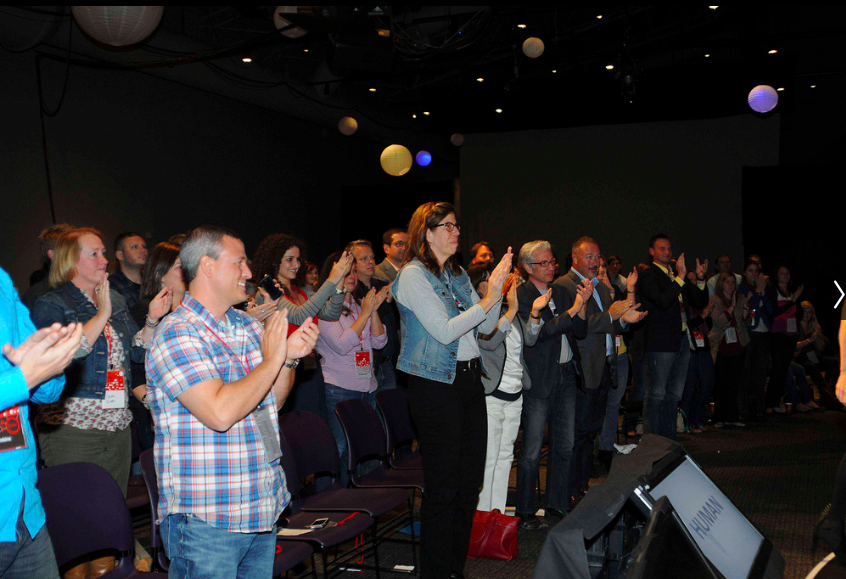
photo credit: TEDxColumbus 2013 and Time Tank Labs
It was five years ago this last winter that I applied for one of the first TEDx licenses. And apparently, I’m one of the few crazy enough get a 6th consecutive one. Our event has grown both in size and maturity, and it’s become a well anticipated event in Columbus each fall.
As we began choosing our speakers this year, someone asked me recently what were the moments when speakers really bombed? I can’t say that anyone really has – but I got to thinking: What were the behaviors that caused a speaker to “disconnect” with the audience?
So here they are: Lessons I learned from the front row (Where I sit every year). Several of the winning points are from my close speaker coaching relationships for some of our sister TEDx events.
1. Tell the audience you are funny. One speaker presented an idea he thought was hilarious but half the audience thought it offensive, rude and reprehensible. The other half did laugh. Had he let the audience conclude it was funny, it may have been more funny. But the tweets were brutal. He decided not to put the talk online.
2. Insert some content that isn’t yours. I had a speaker sign his release at the event and he put an asterisk on it “You may release my video but not the video within it.” Turns out that forbidden video demonstrated the essence, the mojo and the rip-your-heart-out story of why his idea was a rock star. Turns out that video wasn’t his property but someone else’s. While it used to be his, he had moved on but didn’t have rights to it. His talk, despite huge audience approval, also never got posted.
3. Be the smartest person in the room – among a lot of other freaking smart people. One speaker was invite to give a second TEDx talk. His first one was abysmal because he was the smartest guy in the room with 12 really big complicated ideas. My assignment from my colleague (another TEDx organizer) was to help him improve. After I realized he was the smartest guy in the room and didn’t need my help (he refused to engage in any coaching), we let him do what he wanted. So he gave his second talk all on his own. And…he had the same results. Boring stares, no shares. This old dog was not learning any new tricks.
4. Assume we know why YOU care. I asked a very talented speaker to simply give us a line about what gave him license to speak about his topic, which was fairly compelling and exceptionally well stated. His response “Haven’t you read my resume? Don’t you know who I am?” I re-stated it and gingerly asked, “Why do you care about this topic? What moment did you know this would be your life’s work?”…Because I am listening to you deliver a lot of interesting information but will walk away like I do at most restaurants. “Boy the food was good. But who knows what my waiter’s name was.”
5. Refuse to be vulnerable. One speaker was quick to point out all the mistakes in the world that everyone else had made in his draft talk, but protected sharing any mistakes he had made himself. I pointed this out to him and suggested he share a time when he failed and how he learned from it. He refused the advice and as a result, came across as arrogant, showy and preachy. The twitter sphere assured that few would click on his link when the talk was published later.
The TED Commandments and speaker coaching guidance includes the comprehensive list of what to aim for as a speaker. But I submit to you these five, of all the mistakes speakers make, will most quickly disconnect you with your audience, and subsequently, to a wildly successful talk.
No Comments
The alternative to a disconnected, canned, paid Keynote speaker
 I just returned from Dallas and an annual conference for the 250 HR professionals within the Alliance Data family which includes Alliance Retail, Epsilon and Loyalty One Companies. I was invited to curate, coach and host a session called “Perspectives” involving 8 speakers (all associates within the enterprise) for the last day of the conference. Perspectives was inspired by TED platform of highly provocative, concise idea sharing and storytelling. The session was the highest rated by the participants last year that the organizers had no choice but to bring it back. Based on the feedback I got this from year’s session, the response seems to be the same – outstanding.
But why?
Simple. The real, resonating stories from associates who had passion, courage and the willingness to get a big message condensed into 10 minutes connected with every one of the 250 associates in one way or another. They were inspired, educated, energized and proud. Of the eight speakers, four of them addressed workplace issues such as success in a new campus recruiting program, an explanation of talent management, a plea for more mentors and how you CAN change careers. The other four but brought their personal experiences to the talks while weaving in how they impacted workplace performance and connection. They included overcoming deep seeded fear, fighting cancer, overcoming a chronic health issue and being inspired by a child to never give up. Everyone talked about how it offered a needed balance against the other content sessions on executive compensation, HR software updates, reorganization plans, recruitment trends.
The takeaway: A conference with pretty dry, strategic but important information to transmit desperately needs a human element. And while humans may present dry, strategic information in dynamic ways – those sessions don’t always bring a distinct point of view, passion or compelling, resonating stories. They could have spent these two hours on a closing motivational keynote speaker for-hire, but I don’t think any hired keynote would have gotten 10 standing ovations, which is what happened at this session.
I personally was honored to work so closely with the eight speakers and continued to apply and refine The Talk of Your Life methodology toward helping speakers craft, refine and deliver compelling talks without notes or a podium. The speakers themselves offered these comments to me after the conference, validating that this experience is as powerful for them as it is the audience:
Ruth, Thanks again for all your help in making the conference a huge success! The buildup from our people around the talks is just something I have not experienced. You’ve clearly help take our conference to a new level and I’m appreciative of your efforts to get us there. It was a great experience! – CH
Ruth, I can’t begin to THANK YOU for the opportunity to have worked with you! I’m sure you get this all the time but you are truly… truly AMAZING. The feedback I’m receiving really make me feel great and that I actually did this but only with your guidance! You are the best at what you do and I’m so blessed to have worked with you over the last month. – MS
Ruth, Thank you for your guidance and support preparing for my Perspectives talk! There was something incredibly therapeutic, empowering and freeing about sharing my story. The blessings keep on coming. – NT
Ruth, Thanks so much for the experience. It was great to work with you – I really appreciated all of your guidance and support. – CB
Ruth, thanks so much for your guidance and support through our talks. Personally, I couldn’t have done it without you! – DL
Contact Ruth at ruth (at) articulationinc.com to brainstorm how you can improve the experience for your conference or meeting participants.
No Comments
The journey to give a TEDx talk: A documentary.
After the first TEDxColumbus event in 2009 at the Wexner Center, I remember thinking the day after: why aren’t I doing more of “THIS?” This being helping speakers architect their story and find their voice. And deliver what I am now calling “The Talk of Your Life.” It is what lead me to create ar.tic.u.la.tion and the work I do every day.
Now, thanks to video producer Rich Bowers and his desire to follow the success of TEDxColumbus, the journey of two TEDxColumbus 2012 speakers and my passion for coaching people through this experience, we now have this awesome documentary. In a little over an hour, you’ll hear and see the pathway that Naomi Stanford and Jan Allen took on their way to the TEDxColumbus stage, and a lot of my ramblings on how I interpret the TEDx platform, preparation process and my coaching approach.
I’d like to personally thank Naomi and Jan for their participation and extra effort that went into this project. They allowed themselves to be vulnerable, transparent and authentic through each interview. It is my hope and goal that it becomes another valuable and insightful tool for future speakers to use to appreciate the successful ingredients to a wildly successful talk and experience.
Because as Jan said, “You come out of this process a different person than when you went in.”
And here are Jan and Naomi’s full TEDxColumbus talks:
No Comments
The Talk of My Life.
At Prosper!, the Dames Bond conference last week, I was asked to give a TED-like talk entitled “In my own words.” I chose the subject of answering the call – however it might come – and eventually calling upon yourself to recognize your true interests and strengths and pursue them. I’m not usually one for motivational-type speeches (giving or hearing them), so I did what I know best – I picked three stories in my past that lead me to how I’m living out my passion today. And this represents the first time that I come out publicly that (egads!) I was quite a mediocre student growing up. But I wouldn’t re-write that part as it opened doors, er had calls, I wouldn’t normally have had.
1 CommentThe Talk of Your Life.
Which way do you read that?
The TALK of your life.
or
The talk of your LIFE.
I want to talk about both.
In coaching speakers toward a major talk – i.e. a Keynote address to 1000, a major presentation and of course, many TEDx talks – I have seen a recurring theme as one of the outcomes. Many, if not all, as a result of preparing the talk of their lives change the talk of their lives.
“I have not taught the same way since I delivered that TEDx talk in 2011,” reported Dr. Maryanna Klatt, a professor at The Ohio State University.
So what can be learned about how we prepare, organize, sequence and deliver our more casual deliveries of messages from the times that we have to stand at the podium with blaring lights in our faces, headsets taped to our cheeks and an audience of people expecting to be engaged. Even if you never have a chance to delivery that “platform” speech, you will more deeply understand what speakers like Maryanna experienced to apply to your own everyday deliveries.
In this series I hope to tease out many lessons I have learned over the last few years from my clients and TEDx speakers. I have read most (if not all) the books on presentation skills, public speaking, storytelling, but I have yet to find one that anchors from the point of view of the speaker him or herself. As I collaborate with dozens and dozens of individuals in helping them find their voice, their content and their story for the talks of their lives, I hope to reveal insight about mindset, organization, structure, story curation, practice and delivery that others can learn from.
I’m thrilled to have the collaboration of Rich Bowers who last year, during TEDxColumbus, built an archive of video footage for a documentary of a few speakers working their way through the TEDx pathway — from being selected to actually presenting. We expect to do the same again this year to compare with last year’s findings. We wanted to better understand what it took to prepare for this Talk of their Lives. Stay tuned for the findings. They may surprise you.
From the collaboration with Rich in addition to a host of data I’ve collected from my own ongoing clients, I hope to produce a useful series of posts that will help anyone prepare for any talk. Many of these topics I have blogged about for the last few years, but hope to sequence and relate to you, the speaker, in the order you need them. And the expectation is that it may change the way you change every talk you give in your life, not just the TALK of your life.
2 Comments