


What’s Happening at ar.tic.u.la.tion in 2012
No theory or speaker reviews in this post, just a quick update on some of our whereabouts for the new year.
Ongoing Training and Coaching
We are actively scheduling both classes and individual sessions for our Storytelling Training and Presentation Coaching offerings. These are private-reserve classes (no public sessions, sorry) which means we can customize them to your exact needs. We are already traveling to New York, Philadelphia and Cincinnati in the first quarter.
If you don’t have funds to bring us to you, we are now offering Virtual Coaching. Whether its in crafting a talk or getting ready for one, we don’t need to be in the same room with you. We just finished helping a client in San Diego re-write his signature talk, and we’re interviewing a team of spokespeople via video submissions for another national client. Don’t let distance or travel get in the way of raising your bar on your presentations.
TED / TEDx Initiatives
In February, we’ll be helping to coaching the first ever TEDxKids event in Ohio at an aftercare program. Watch this blog for some updates on how it goes, especially since the kids are in 1st, 2nd and 3rd grade. The kids will unveil their great ideas on how to make Columbus a better place during its Bicentennial year on February 17.
After that, Ruth will be attending TEDActive in Palm Springs. If you are going and want to connect, send her an email!
We’ve got a whole line-up of TED viewing events we’re planning this year, leading up to our big live stage event on October 5 at COSI.
Women’s Fund
We’re proud to be an in-kind training partner this year of the Women’s Fund of Central Ohio. On January 25, we’ll be coaching their grant partners on how to architect their best story. At the end of June, we’ll help their leadership get ready to take the stage with Whoopi Goldberg at their annual Keyholder Event.
Blogging, Writing, Reading and Speaking too!
This year, our interests are going to turn deeper into the psychology of nervous behaviors around public speaking and in refining a a few new storytelling classes in partnership with Thoughtleaders. We’ll be blogging here as much as possible and addressing a few audiences ourselves. We love to present too!
Feel free to submit questions or ideas to us here, as we continue to help accelerate your presentation and public speaking skills.
No CommentsSpeaking when your medium isn’t language.
On the TEDxColumbus stage over the last three years, we’ve had a variety of performance artists: musicians, poets and such. This post is not about them.
It is about those individuals who have a medium other than their own voice, movement or acting to express their artistry (design, painting). I turned to wikipedia for a definition: An artist also may be defined unofficially as “a person who expresses him- or herself through a medium.”
But what happens when you ask an artist to communicate their thoughts in another manner – most commonly, language (written or spoken) – that also has critiques, deadlines, a huge audience and permenant record through video?
My hypotheses is that when an artist whose medium is not language is forced to communicate his/her work through language (spoken or written) the process is troubling.
So something oddly coincidental happened within the 12 hours before our TEDxColumbus 2011 event. Of the 18 speakers and performers, 3 of them attempted to impose changes to their slides within 12 hours before the program began. And by all accounts, they were the three artists of the group who were going to speak.
They otherwise distinguished themselves by a few screaming characteristics. And the fact is, I’ve had several other clients and TEDx speakers who have exhibited the same behavior. But it wasn’t until I saw them side by side within 24 hours did I finally get it.
The characteristics were:
– The process of preparing a talk was torturous. Having to meet any deadline, having to go through any edit or review, having to had the talk DONE before the talk itself was simply a life-altering experience. And not always a good one.
– Their topics kept evolving. Sure, they were generally in the same realm of the idea they originally proposed discussing, but the end result was fairly far distant from where we started. Imagine someone saying to you: “I’m going to be a devil for Halloween” and they turn up on stage looking like an angel. That might be great for Halloween but not a TEDx talk.
– To the aforementioned point, they never finished their talk so therefore they didn’t really practice it. And when they showed up to rehearsal, they were still in an edit mode. And the next day, another edit. And really, through their sleep the night before the event, another.
– In hindsight, they wanted to talk about a different topic altogether. Everyone wants to give a different talk after they’ve given one, that’s pretty common. But these folks wanted to pick a different topic.
Earlier this year, I had the pleasure of working with another local artist in preparing for a book tour. When we were done working on her talk, she said she thought she needed a second talk. The creative genius in her didn’t want to be done.
I am placing no judgment on the way these colleagues of mine navigate the pathway of getting on the stage to make remarks. I’m simply suggesting, if you are one of these people, please remember that the best talks benefit from rehearsals and practice. And if you are in a constant state of revision, then the talk never quite is done and well, probably is never really practiced.
Be okay with a moment, just a moment, of ‘done.’ There will be plenty more revisions to make to artwork, drawings, concepts and plans that don’t involve an audience trying to follow – or subsequently share – your ideas.
2 Comments
Three times makes it a trend
They say once is an event, twice is a coincidence and three times is a trend.
As we organize the third TEDxColumbus event, we’re definitely feeling the trend. Consider our first year when no one knew what TED or TEDx was. I had to explain, clarify, demonstrate and explain some more. Last year, we had some awareness but still needed to prove we could do it again. And this year, we’re now managing people’s interest, excitement, investments and involvement.
But more importantly, we’re helping with three other events that are by-products of this trend.
Next week, a statewide STEM conference will take place where their three “keynote” speakers will deliver 18- minute TED-like talks.
The following week, I’m giving a talk at CityWorksXpo, a national conference on small cities. The organizers wanted to share the essence of TEDx with the cities that had not yet embraced one. While TED doesn’t like to promote TEDx in the traditional way, I’m happy to provide some front-row insight and outcomes to what a TEDx might inspire within a city.
The next week, a major company in town is having a day-long marketing summit with their 200 internal marketing professionals and 12 ad agencies. Instead of having the agencies present creative work, they turned to me to curate (that means concept, recruit, select and coach) a morning slate of TED-like speakers centered around a compelling, futuristic idea that will ‘wake up’ their brains to where their industry is headed.
And then lastly, our main event on 11.11. We announced the speakers this week and are humbled and honored to be working with such a dedicated, passionate group. We’re expecting 500-600 to attend a full day “Moment in Time” featuring 18 speakers. That’s definitely a few steps away from our 5-hour, 8-speaker evening event the first year with just 300 in attendance.
No CommentsThe Coaches’ Coach.
My normal client is the person or team that wants to up their game in their critical thinking, storytelling and/or presentation skills. Last week I switched hats and became a coach to the coaches.
A group of curators from TEDx programs in San Diego and Jackson Hole asked me for some help in how they should coach their speakers. So I put together my thoughts, we fired up a webinar and I woke up from an early evening nap to join in the group at 9pm (my time!). I was supposed to be teaching them tips, but instead, I learned a few things too. Here are three worth sharing:
A. When coming up with an idea to discuss, always challenge yourself to think bigger. San Diego had a speaker who was a “Horse Whisperer” but her real idea was about how we listen to and respond to things in nature. The assigned coach struggled with the “so what” when discussing the Horse idea, but got to a “aha” when we moved it one level higher.
B. Don’t assume your speakers will understand the basic tools of a great talk (besides their big idea). Included but not limited to: the opening hook, making the audience the central character of the story, give them the bottom line first and create visuals with WORDS first and then resonate them further with images. If someone hasn’t ever given a talk before, these tools will help anchor the beginning of a great framework.
C. And lastly, you can make a good speaker out of a great idea. But you cannot go the other way. As we were talking, I was reminded that it’s really okay if a speaker’s style does not outshine their idea. But even a bad idea cannot be saved by a great speaker. (And in the case of a TEDx organizer, it is a big hairy sign to not extend the invite to speak).
I’m happy to send the webinar recording to anyone that would like to see it. Just email me here.
No CommentsWhat’s your hook?
Late last year when we started paying close attention to good opening hooks, we started noting those TED talks that had particularly good ones. In this 3 minute video we produced below, we’ve spliced out 6 really notable ones, and what we consider a represenative sample of the different types of hooks you can deploy. From self-deprecating and provocative to extremely unexpected and wholly unrealistic (can you tell which one that is?), you might be inspired to try a different approach in your next talk.
See which one grab you best?
Great Opening Hooks from Articulation on Vimeo.
No CommentsHook ’em.
Everyone has their pet peeves. I have my pet loves. Among them, really awesome opening hooks. As in, how do you grab your audience from the first words out of your mouth. That means, ‘Thank you for having me,” or,
“I’m here to discuss an idea…” are no where to be heard.
This week at TEDGlobal, among the 12 or so talks that I got to hear live (via our TEDxLive@Columbus livestream), two grabbed me:
Pamela Meyer’s talk on Lies. She opened by accusing essentially everyone in the audience of being a liar: “The person to the right of you is a liar. The person to the left of you is a liar. And the person sitting in your seat is a liar.” (paraphrased since the talk is not published yet. I’ll link it here when it is.)
Aside from an artfully chosen opening, her talk continued the same engaging cadence, weaving story and fact, detail and reason. Not to mention, she provided some great tips on how to spot a liar (hence the name of her book, Lie Spotting).
Now, if we believed in the rules of PERP (the sequence that helps audiences overcome the communication bias — Point, Example, Reason, Point), the next TEDTalk by Tim Harford, also a TEDGlobal speaker this week, violates them. We aren’t exactly sure what his point is since he starts with his example, and he risks losing the audience by not sharing where he’s headed at the start.
But it matters not.
His opening hook story and his engaging storytelling style keeps you rapt to want to know more. And in particular, how he’s going to weave it into a poignancy to which we’ll relate and want to hear more. Watch it here:
Lesson is: Make sure you have your opening hook planned carefully. Usually I suggest writing it last after the rest of your talk is complete. Those nervous jitters can lock you down for the first few minutes of any talk — which is when you need to be most engaged and captivating.
No CommentsTED 2011: Wondering if I’ll ever recover….
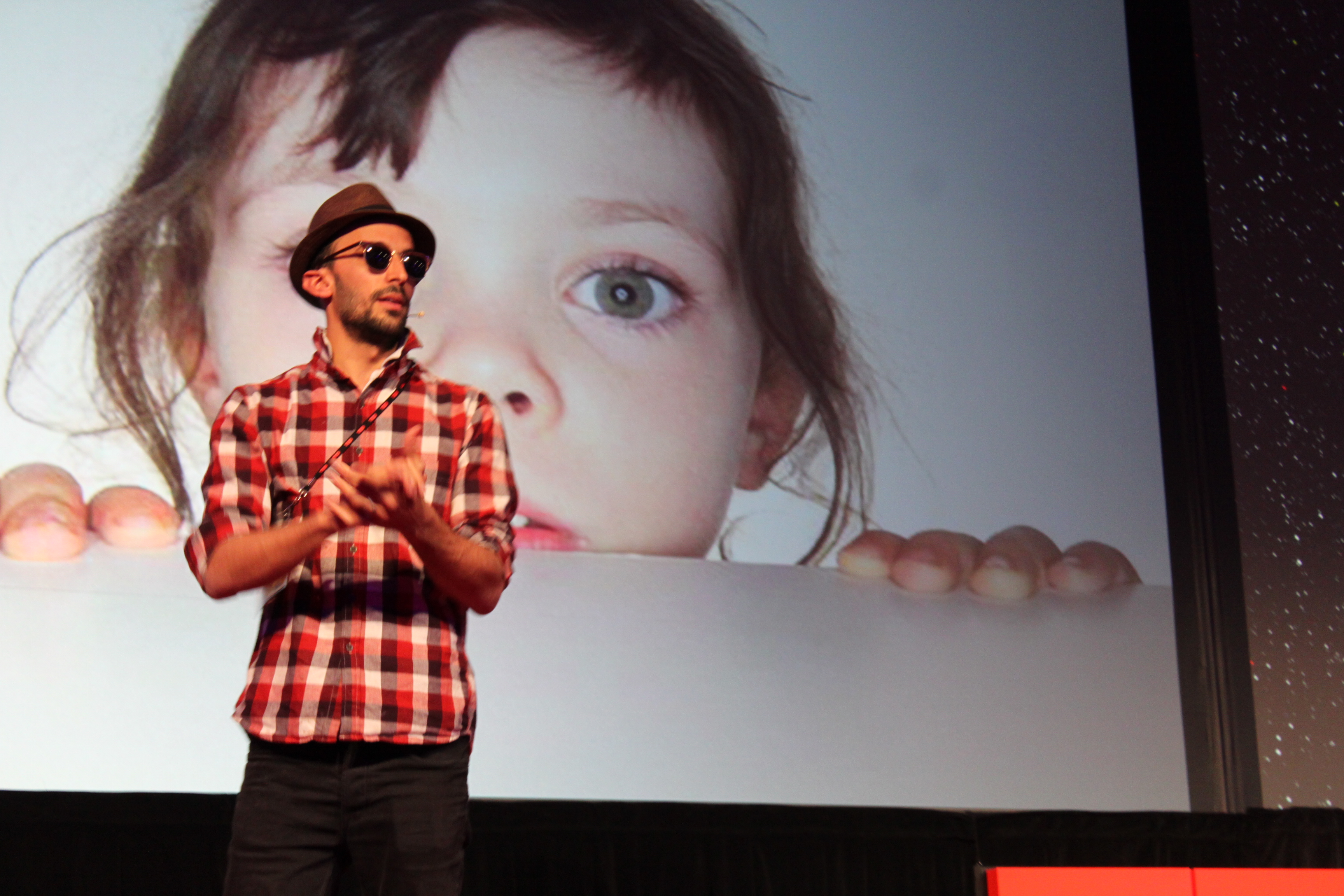
We got a rare audience with JR the artist, who came to talk with us about his TED Prize.
Consider: We spend 4 billion hours in traffic. There are 1 billion people in the world with a brain disorder. For every 400 movies made, another 11,000 porn flicks are produced. And there are 113 official ways to die in the US. These are but a few of the interesting bits I absorbed at the 2011 TED: Rediscovery of Wonder conference. But you don’t go to TED just to learn facts: you go to get immersed.
And indeed I was immersed and energized, inspired, bewildered, exhausted, touched, bedazzled…and more.
We heard about innovations that are enabling paraplegics to walk, the blind to drive, our taste senses to be teased, how cars will drive themselves, algorithms that are stunting democracy, how cyber-attacks are more deadly that weapons of mass destruction, how books can be interactive, that energy can be modular, how pixels can fly and voices merged for a beautiful internet choir. We heard from a sevent whose senses cross-talk, a worldwide famous Chinese artist whose name cannot be found in a Chinese search engine, a woman who finds light at the bottom of the ocean, a family who videotaped years of home life to learn language patterns, and a man who is literally printing organs.
As a result of being immersed in the real (the conference was broadcast from Long Beach from TED) and virtual (I watched from TEDActive in Palm Springs) presence of amazing thinkers, innovators, scientists, designers, activists and more, I decided to share some of the more memorable quotes I managed to catch. Within each you can get a taste of the individual parts that made up this memorable event.
11 for TED 2011
“They publish photos, not excuses.”
– Phil Nicklen, the National Geographic photographer, on how he had to stay motivated to pursue his mission to swim with and photograph leopard seals, who were previously believed to be deadly to humans.
“The future has arrived, and the future is now.”
– Wadah Khanfa, Al Jazeera’s Director General, on the developments in Egypt, Libya and surrounds.
“When I finish I have the answers.”
– Sarah Marquis response to why she chooses to take 2 year treks, by foot and alone, from places like Siberia to Austrailia.
“One of the hardest things to know is when you don’t know.”
– Futurist Juan Enriquez in introducing one of the speakers he curated. Interestingly enough, I had no idea who Juan was and it proved to be a delightful experience in listening carefully to his words to understand why I should trust this man I didn’t know.
“All the connections of the things around you define who you are.”
– Aaron O’Connell, relating his breakthrough theories of quantum physics
“People learn from people they love, but that reality is expunged from politics.”
– David Brooks, on the disconnect between politician’s innate ability to be interpersonal with people, but not policy.
(And one more from Brooks’ talk: “They don’t have thighs but elegant calfs on top of one another,” during his riff on the uber-mom).
“Doodling is a pre-emptive measure to help you keep focus.”
– Sunni Brown on why the doodler is under-appreciated in society.
“There’s never a wrong time to do the right thing.”
– David Cameron, as quoted by Bruce Aylward from the WHO, on the pursuit of the eradication, not just control, of Polio.
“Can’t have a functioning democracy without a constant flow of information.”
– Eli Pariser on the scary algorithms that Google (and others) are deploying to narrowcast news to us.
“Chaos happens, make better use of it.”
– Ed Tenner on unintended consequences.
“We will look back on a time when people will say how ridiculous it is that people are driving cars.”
– Sebastian Thrun on the driverless car he’s been developing.
Other thoughts….
I would be remiss not to give kudos to the 50+ speakers for their outstanding performances. Because giving a TED Talk is hardly just a talk. While some were obviously more memorable than others, I was impressed with the judicious use of visuals, the arc of each story and true desire to connect with the audience. Likewise, a huge bravo to the TED staff. My experience at TED, watching the talks with others, meeting colleagues from across the globe, was a rare and special time. (Thank you!)
Excuse me now while I go check on the cast that is supporting all the brain muscles I pulled living through, thinking about and reporting back on TED. It’s a good kind of sore.
(All talks referenced above will be archived on TED.com at some point. To learn more about any of the speakers, start with this page within TED to begin your crawl down their rabbit holes. Enjoy!).
No CommentsLive from the Desert.
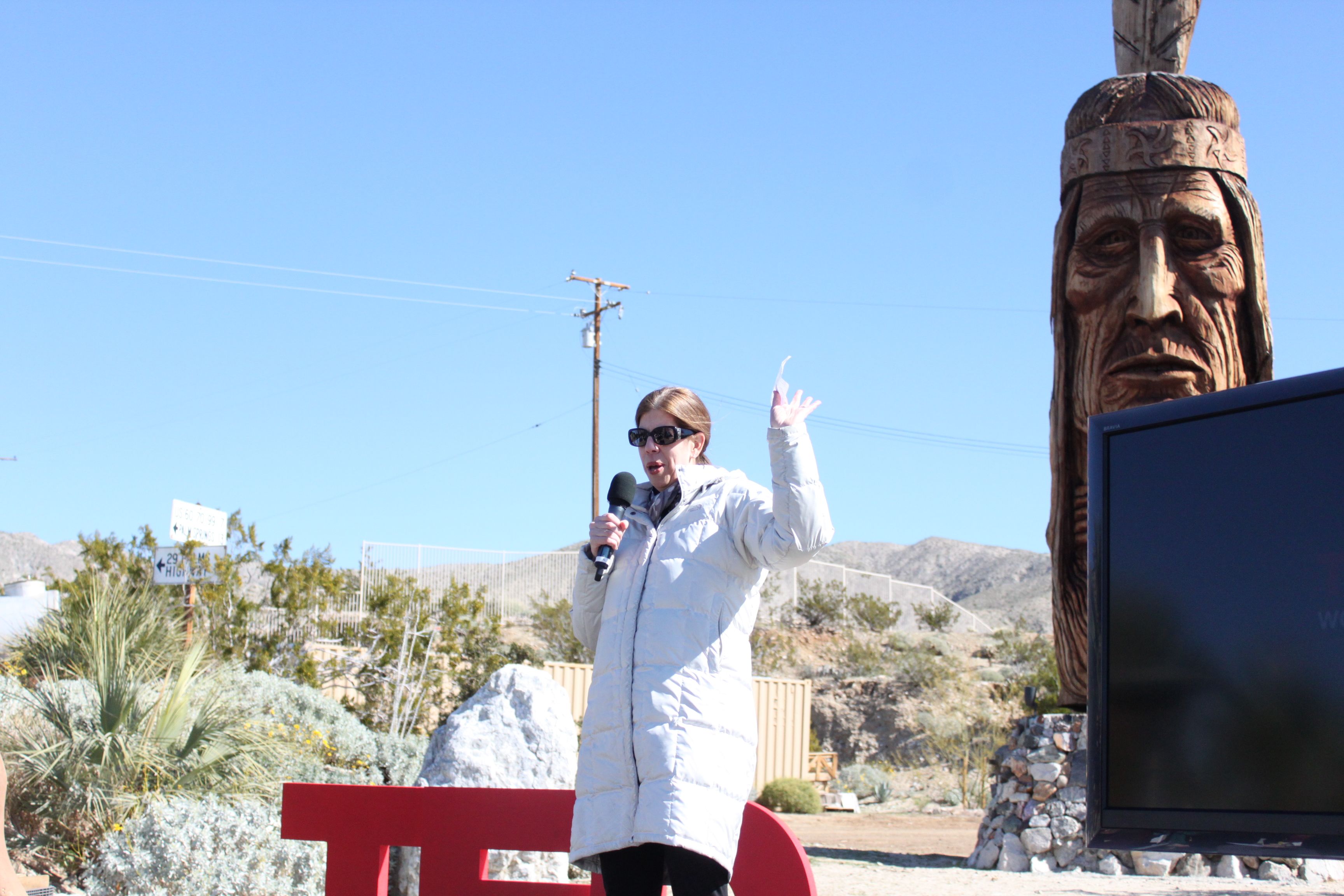 Palm Springs, the TED staff held a special workshop day for TEDx organizers. I gave a brief presentation on speaker preparation to my peers and
From Ruth: 25 years in the making
San Diego, August, 1996: I was sequestered for a day in the speechwriters’ room behind the big stage at the Republican National Convention. I was there to “traffic” a speech. I was charged to make sure the one that was supposed to scroll on the teleprompter was the one my ‘principal’ was expecting to give, er, read in front of hundreds of thousands of TV viewers. Read More
No Comments