


The Value of ‘Values in Action’ Stories
So I guess if you don’t have company values, it would be hard to tell any “values in action” stories about them. But the reality is, we all drive our businesses on a set of SOME values – and we behave consistent with them every day. Harvesting those stories that best demonstrate how you live out your values needs to be an intentional effort, however, so they can be shared and passed around — building trust, resilience, reputation and maintaining a vision.
At the 2012 Annual Meeting of the Greater Columbus Chamber of Commerce, resource interactive Founder Nancy Kramer gave a resonating and lively speech reflecting on her company’s values and how they positioned resource for sustainable growth. We were fortunate to have the opportunity to partner with her on this talk, which, as you can tell if you watch through to the end, made it one memorable event.
Once you are done watching the talk, see if you can repeat back the stories she uses to demonstrate their values.
1 CommentThe problem with the panel.
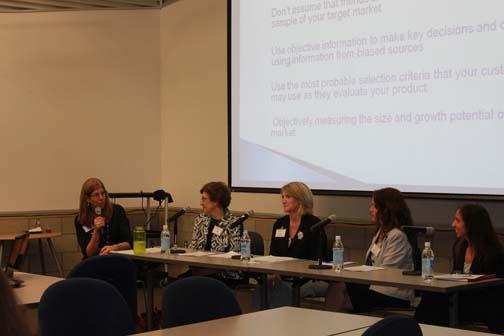
TECHColumbus Marketing Technology Panel. September 7, 2011
Let me thank the panelists from last week’s Women and Marketing event at TECHColumbus: Joan Manter, Nancy Bohman, Amy Marshall and Padma Sastry. I won’t repeat the content of the panel discussion since Nancy has a wonderful recap on her blog.
But what I do want to explore for a moment is the notion of the panel as a presentation format.
Yes, it may seem hypocritical that I’m in the photo above moderating last week’s panel and now want to question its veracity.
The reality is when I accepted the invitation, I insisted that we all gather to map out a ‘panel plan.’ And indeed, I made good on my promise and helped them wrestled a narrow topic presented in the form of five thought-provoking questions that each of us would answer. While unstated to the group, my goals in facilitating this plan were:
a. Do not have any replicating content, i.e., we each need to say something worthwhile and different;
b. Find a quality example (story, anecdote) to illuminate the ‘answers to the questions,’ i.e., give what we say a fighting chance to be remembered;
c. End on time, i.e. if we are remembered for anything, don’t make people blame us for being late to work.
So, interestingly enough, I believe the general goals from TECHColumbus in having the panel were to:
a. explore a topic that would attract an interesting group of women
b. showcase some industry experts on their turf
c. facilitate networking
All really noble goals.
But therein lies the problem with the panel, in general. It is not designed with the very broad audience in mind. At least the audience as a person listening to content. Trying to decide what is important. Who is credible. What they should take back to their desks and repeat to their colleagues. In between three cups of morning coffee. Rather, it is designed with the audience as a person who wants to network and be seen.
I visited Wikipedia a while ago on a whim looking for insight. My hypotheses was correct (for once). The “panel” was created as a listening tool, not a talking one. As in panel of judges, listening to a case.
You can see from Wikipedia’s list of purposes that a panel serves, none of them center on inviting a group of people who don’t know each other to sit together and talk to others who are there to listen. It is usually the other way around.
I asked someone at our local discussion forum which I admire greatly, Columbus Metropolitan Club, once, why do you have panels? And his candid response was: it helps to drive a crowd. If there are experts on the panel with whom people can affiliate, then there will be attendance. Fair enough.
But I’ll say it out loud. As an presentation format, I’m not a big fan of the panel. Tough for panelists to get connected, coordinated and in a good flow; tough for the audience to follow, comprehend and be impacted.
As a tool for resonating an idea, creating buzz, telling a true story, transferring knowledge or even evoking one emotion, don’t look to the panel.
As a tool to market your organization, gain some awareness, or as a vehicle for networking, sign it up.
No CommentsTALKBACK: Irene Navitadad
Talkback is an occasional series of review of live talks we’ve attended.
I’ve been listening to speeches the last few months with an eye to “the story.” You know, the example you give that transports you to a place with real sound, smell, taste and an example you can most assuredly repeat. That relatable moment that says I want you to care. And I want you to root for my message.
Yesterday, I went to lunch to hear Jane Goodall. She expectedly talked about reforestation, roots, shoots, chimps, apes, conservation – and waitressing to make enough money to take the boat to Africa to live her dream. Every word was rich with visuals, emotions and passion. She was sweetly elegant and so personable too.
But obviously, that’s not when I was craving a story.
Last night I went with an open mind to an event for women in economic leadership to hear what Irene Navitadad‘s story was going to be. She’s the President of the Global Summit of Women. I like the organization and was invited by a friend, but I really was hoping for a knock out talk.
During her 25 minute keynote at the “WELD KEYNOTE EVENT” focused on the status of women and where they land on corporate boards, in elected positions and what place women have at the table — the reality is, she told one repeatable story.
And it was about a man.
By all accounts, she was a very energized speaker. Great presence. Good delivery. Nice connection with the audience and seemingly a very approachable, real human. That is important toward the ‘believability’ factor of any talk.
But at a dinner event with 500 attendees, of the five slides she showed, four were (small) charts and graphs. Data from all over the world. Data I wasn’t sure what to do with in my life here in Columbus.
She did have one photo she started with – of a bunch of women opening the stock exchange in Madrid. By all accounts, it was a story to give her credibility to talk about everything else. But it really wasn’t a story. It was a proof point that she was doing her job well in getting women in great photo ops in places of influence.
I wish I had counted how many facts she shared. They were eloquent facts, indeed. But oh dear, after my 2 glasses of wine, I couldn’t remember one from the next.
So during the Q & A she shared the story of how former CEO of HP Lew Platt‘s wife died and he wanted to be involved in the raising of his children. He had to make unexpected sacrifices to his schedule and consequently, started to change the culture at HP to support other parents who were also raising children. I presume, since she chose to tell the story, that it became a model for many other corporations to follow.
Her point in a roundabout way was that unless women are in positions of influence, policies impacting women and families won’t be affected. She attempted to connect issues of better governance, tighter run meetings (and on time) and maybe another point – but I can’t remember one because I wasn’t transported to the ‘so what’ moment that is best answered with a great story.
So it may be ironic that when the woman that comes to talk to a group of 500 women about women’s place in the world ends up talking about a man.
Now that’s a story I will remember.
1 CommentTalkback: The way you move.
Note: This is the first in an ongoing series of reviews of live talks called Talkbacks that we’ll be posting on ar.tic.u.la.tion. Some reviews will be full critiques while others will share inspirations from the viewing experience.
Jim and Nancy Petro have risen to the top of the many lists in their lives. Jim was once Ohio’s Attorney General and Nancy has been a leader in various business endeavors. But today, their talk was about their work on those who have been wrongfully convicted.
Since they were interviewed by a Columbus Dispatch reporter, their talk was classified more as a conversation than a speech, lecture or keynote. I was struck however, by a comment they made regarding how evidence is collected from eyewitnesses during an investigation.

I’ll paraphrase here:
“When collecting eyewitness data, the investigator should not have any knowledge of the case or what the ‘truth’ might be. If they do, their non-verbal and body movements (such as nodding, facial expressions, open or closed stance, nervousness) can directly impact that response that an eyewitness gives.”
In other words, a person’s life or death can be hung on the non-verbal reinforcements of a police officer or other investigator who knows the answers when questioning the eyewitness. If they are unaware of the situation, then their non-verbals will have little to no impact on the answers. And as such, may not sway an eyewitness one way or another.
The takeaway: we have little idea the big impact our nonverbals have on our everyday communication – let alone our critical communication.
I’ve discussed this before, especially in the case of Jamie Oliver’s TED talk (and his 100 steps in the first 3 minutes) that show his nervous energy. And I certainly focus heavily in our coaching on the impact that hand gestures, stance, pacing and head movements have in helping to communicate – or present a barrier to communicating – a message. That is not new.
So could an innocuous nod, an unsuspecting squint, a pursing of the lips, a shift of the eye, a petting of the chin, a tussling of the hair really seal someone’s fate in a process of being convicted? Perhaps for a crime they didn’t commit?
Jim and Nancy Petro think so. You’ll see it in their eyes when they tell you about it.
No CommentsTalk Back: Tis the Season.
Every May and June for 15 years I’d tune into CSPAN and watch graduation speeches. Thank goodness I got married one June and now have a few better things to do with my leisure time. But hearing about graduation speakers the last few weeks brings back some of those memories and how I would look for the most compelling, prepared and memorable.
Now with the internet and Youtube, these speeches are widely published and you don’t have to be on your couch at the exact moment CSPAN broadcasts them.
In our random completely unscientific review of about a dozen addresses, the best were ten minutes or less and got straight to the point from an unexpected personality. The expected ones were the ones who get paid to normally speak (news commentators) and had a packaged, well-researched, attempting to be funny address. Those are the ones everyone forgets.
In the one we’re posting here — we give props for being truly entertaining with a delightful dose of self deprecating humor. And it was nice to see that the audience could have fun, even stuffed under all of those robes and hoods. (Side note: I think it’s the only school that has commentators offer play-by-plays of all the commencement activities like a horse race. See, I’m not the only one that considers this a sport.) So…enjoy Jimmy Tingle @ Harvard 2010.
Talk Back: “What If” conference
Talk Back is an occasional review of talks we’ve attended or heard.
Yesterday, it was a delight to attend the first “What If” conference at the OSU Fisher College of Business. It was a showcase of successful entrepreneurs and their various approaches to innovation. Each person was given 20-30 minutes to present. To keep it light, I’ve given each of them an appropriate award, helping to highlight their most memorable speaking attribute.
Before I dig into my list, I was reminded of my favorite excuse TO prepare for a talk: if you do a great job, we remember what you said. If you don’t, we remember why we don’t.
The best smack down of the topic conference: Hands down goes to Kelly Mooney, President and CXO of Resource Interactive. She designed her talk around one simple innovation that her firm had developed; not her philosophy in innovation, but a practical application to their commitment to it. As the conference title suggests, the talks were supposed to help understand what happens when you say “What if..” we could mix that idea with that other concept? Or achieve those results? What would our innovation look like if we allowed ourselves those questions? Kelly’s slides were clear (although I’m still very hesitant to endorse screen shots of web pages – in this case they were not meant to be read so it worked), designed around the theme and her talk was tight. She had to keep a good pace because the conference was running late (more on that later), but not too fast for her to abandon her confident but conversational style.
The best TED talk: Peter Thum from Ethos Water. Why? Because Thum is a TEDster and given a TED talk before. The What If? conference in one of its promotional pieces, actually suggested that the talks were in the style of TED. As a TEDx organizer, this is a style I’m intimately familiar with. He had clear command of his topic (never once looked back to a slide), had slides that were image-rich (no words or few), had a friendly and easy pace to follow, projected well, sequenced his story for easy following and didn’t drone on forever. All things you learn by giving a TED talk. If you want to achieve that, just watch a TED talk every day for the next two years (there are that many).
The best verbal style: Sherri Geldin, Director of the Wexner Center for the Arts. I have long thought (and have told her as much) that she’s got a terrific oratorial style. Exceptionally confident, very well paced – you never ever hear her rush – and enough graduate words that give her credibility with the high art crowd. Now, I say verbal style because she’s got one barrier to her having an overall speaking style – she won’t talk without a podium. As such, most of us couldn’t see her because the talks were designed to be integrated with the audience and the podium was hidden to the side. Word has it she didn’t spend a lot of time preparing her remarks – barely would have known it. She can amply think on her feet, hopefully she’ll let her feet move when she talks in the future.
The best story: I may be partial, but Martin Keen’s journey from being a sailing student at OSU (seriously?) to being one of the leading designers and manufacturers of outdoor footwear, you know the ones bearing his name, was really inspiring. I loved his imagery that supported his talk even if his delivery wasn’t the most outstanding. He did a great job opening and relating to the audience, especially sine he hadn’t been back on campus for 21 years. Indeed, he put the conference in a bit of a scheduling connundrum with his length. I know It’s hard to stop someone that hasn’t been back on campus since they graduated 21 years ago and has since built an internationally known brand. It’s a note to self for the organizers: clear expectations up front and use the hook the minute they go over. I do wonder how many students were wearing his shoes in the recent flashmob.
The most memorable shirt: No other contender in this category except for Bruce Lavash from P&G who wore a Hawaiian fashion. When you have 30 patents to your name you are allowed! I’ll be sort of tough here and say he showed a bit of unpreparedness with some horrible dry mouth about 3 minutes in — a true sign of nervousness. He was energetic and passionate, but the only thing that grabbed me at the top of his talk was the shirt so I excused myself to use the restroom and return a call. A good lesson in audience engagement – get to the point or you’ll lose them. As a result of leaving for a bit, I also missed the founder of Wikipedia but the buzz in the room was that he was engaging and interesting.
Most sincere: Jeni Britton, Jeni’s Ice Creams. She told me after that she didn’t want to do it since she didn’t have much time to prepare. Barely showed. She admitted mid-talk that she was used to having her kitchen in front of her when she talked (or rather, cooked) and did exhibit a little nervousness by looking at the screen to make sure the audience looked there too. And her set-up was hard to beat: she got to end her talk by inviting everyone to sample two flavors of her exotic ice cream. She certainly fooled us if she wasn’t prepared as we all enjoyed a scoop.