


Let it go.
 I just finished a six week assignment with a major health corporation in town, helping them to cascade their 10 year vision into a repeatable resonant story for their 16,000 associates to understand. The experience was a familiar one — take two years worth of strategic planning work and find a way to get it into 10 minutes. That was not the difficult part, in fact it was great fun.
The challenge was when the lead executive insisted on telling “the journey” every time he presented the material (at least when I was present). He was afraid that people wouldn’t appreciate how far, how hard, how complicated it was to get to THERE. He wouldn’t let it go.
I’ve seen this more and more lately — whether it is a mid-level data analyst or a senior strategist, the desire to relay everything about “the work” has become consistent — consistently unnecessary. We, in the audience, gingerly ask ourselves: “Who cares?”
When you think about this question: What do you want people to do with the information once they leave your presentation?, is the answer:
A. To know how hard you have worked
B.To make sure they know every step of your journey — or —
C. To take action on what you are presenting
Clearly, it is C. But our ego and self-consciousness get in the way of remembering we need to keep the audience the central character of our story – not ourselves. The fear: if we don’t display the tough journey, we won’t be acknowledge for all the effort we expended. The reality: if we don’t tell people the bottom line in a succinct way with resonating stories, all that effort will be lost.
Let it go.
1 Comment
It takes both sides.

The story behind these shoes require both fact and emotion to understand them fully, just like we need the right and left to be able to walk in them (if we were so bold to try!).
Yesterday morning I delivered a keynote address on influential storytelling to 80 executives at the company DSW, headquartered in Columbus. They sell shoes and lots of them. In attempting to find the perfect metaphor to begin my talk, I made them each take off their right shoes. To a group of shoe execs, the energy in the room went from “Who is this woman and where can I get more coffee?” to “This may be fun.”
In the class and also this keynote, I always stress the importance of a balance between the objective and subjective information you should share in any talk or presentation. It is just the way our brain works. We crave to know how many people died in the plan crash before we hear one of the tragic stories. We love to hear about how sales went “through the roof” but we want to know how high with specific numbers.
So I told them to take off their right shoes and walk around a bit. I then suggested to them, after they felt the discomfort (especially the women in 5 inch wedges) that this was like giving someone data and fact only. Or better yet, selling people only the left shoe. I asked them what would happen if you only offered “lefts” in your store. One exec aptly replied “Your customers would walk out.”
Exactly. Because that’s what your audience does when you speak to only one side of the brain. Turn around and walk out.
No Comments
When do you NOT need a story?
I got that question on Friday while I was training 80 HR trainers in our all-day Influential Storytelling workshop. I promptly replied with an unusual thinking-out-loud-rambling-answer that “I didn’t think so.” Then I promptly told a story why.
I was reminded when I heard this talk a few years ago when I sat in the audience craving a story to balance out the facts she was presenting. At the end, she told a story, but a wrong one (in my opinion). Her message did not resonate and in fact, it lost credibility with me.
Remember, the definition of a story is the bridge that connects what you do know and care about with what you don’t yet know and care about.
I went through several scenarios to test if there was ever a time you didn’t need one. Here’s my result:
– When you have data to share. Sure, you can use a story to help shape what the data is saying.
– When you have a procedure or how-to list. Of course, sharing a story can help someone sequence in their mind the steps you expect them to take.
– When you have an analysis or trend. It would be hard to share the trend without demonstrating one of the stories that represents the trend, right?
– When you want to introduce someone. Well, that in and of itself is a story of who they are.
– When you want to explain a rumor or challenge. It’s likely a metaphor will be needed to explain the vision to emerge from it.
I’m open, but having a hard time finding a time when a story can’t be used. It may not always be needed – but certainly, it can be desired – especially by your audience who wants to connect with your message.
No CommentsWinning the Business Competition
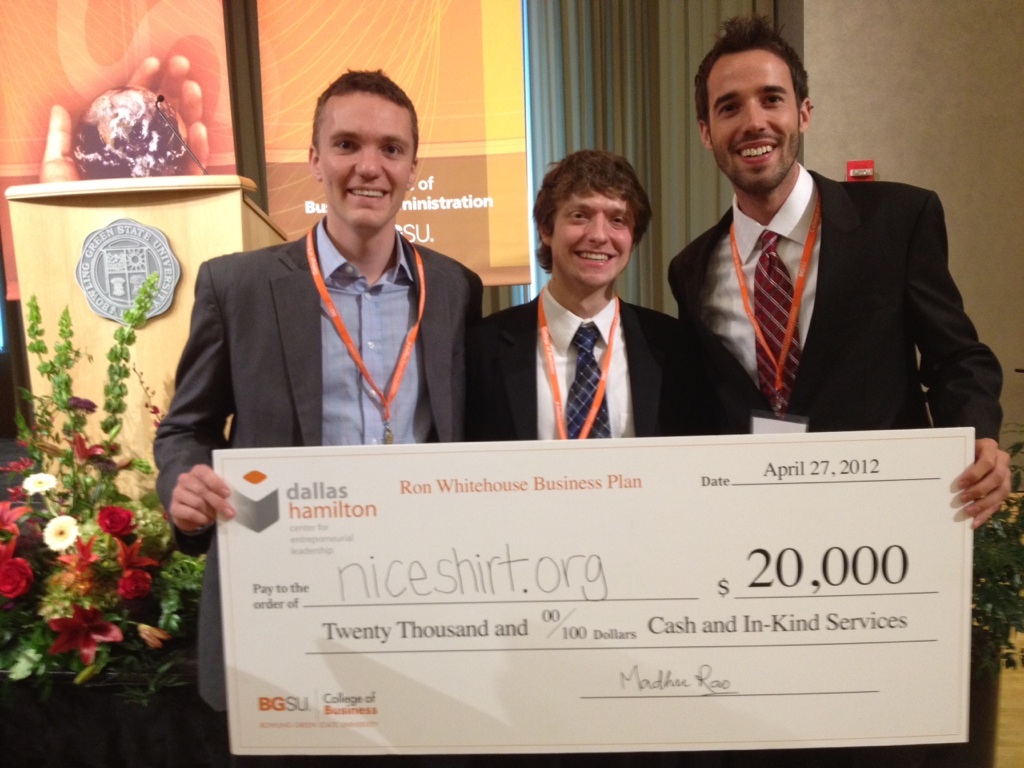
Every now and then, we get an invitation to work with a different type of client – and we love the opportunity to adapt what we do for someone new. So when Skyler Rogers, a senior at BGSU and former TEDxBGSU organizer, reached out for some help with his business competition pitch (an old concept that’s getting new energy these days), we jumped at the chance to help.
He was given 5 minutes to talk in front of an audience that would then vote for their favorite business plan. The stakes? $20,000 of cash and in-kind help for his new business called NiceShirt.org. Not bad for a guy who in a week will graduate from college.
At first, we were skeptical – how could we make a tshirt business come to life and win over the hearts of the 500 attendees who were voting on the winner? The answer became readily available to us when Skyler started sharing stories about how his shirts have helped very good causes that otherwise would have huge barriers to using apparel as a fundraising strategy.
His model was simple – if you want to sell shirts for a good cause, let us do the design, printing and distribution for you – and we’ll send you the proceeds for your cause. No more negotiating with vendors, figuring out how to distribute 5000 tshirts or what to do with $20,000 in cash (as evidenced by a case study he cited about a 16-year old kid that found himself in just that predicament).
His opponent showed a number of charts and graphs – detailing the business projections of his enterprise. Skyler told four distinct stories that demonstrated the villain (the problem) and the hero (his idea), and who would benefit (the people and their causes) and how. He didn’t show one financial graph or data chart. And as you can figure out by now -between our pride in this post and the photo above, he won.
I got a text from him after it was over, and he said “I even saw some people tearing up in the audience.” Yep, even t-shirts can make people cry. And when they cry, you’ve touched their emotions and moved them to action.
Thanks, Skyler, for working with us and congratulations! We can’t wait to hear where NiceShirt.Org takes you – or you take it!
1 Comment
Our Influential Storytelling Class
Last week we re-launched our Influential Storytelling class. Like all good motors, it needed a tune up, and just in time too. These 15 participants came together from 7 different organizations to get down to the business of “story.”
One of the attendees in his evaluation said:
“It is rare that one experiences something that could truly change the way they behave. I like to tell stories but often feel that I give way too much info in the beginning and never get to the point. The idea of “architecting” stories is powerful AND I plan to use it.”
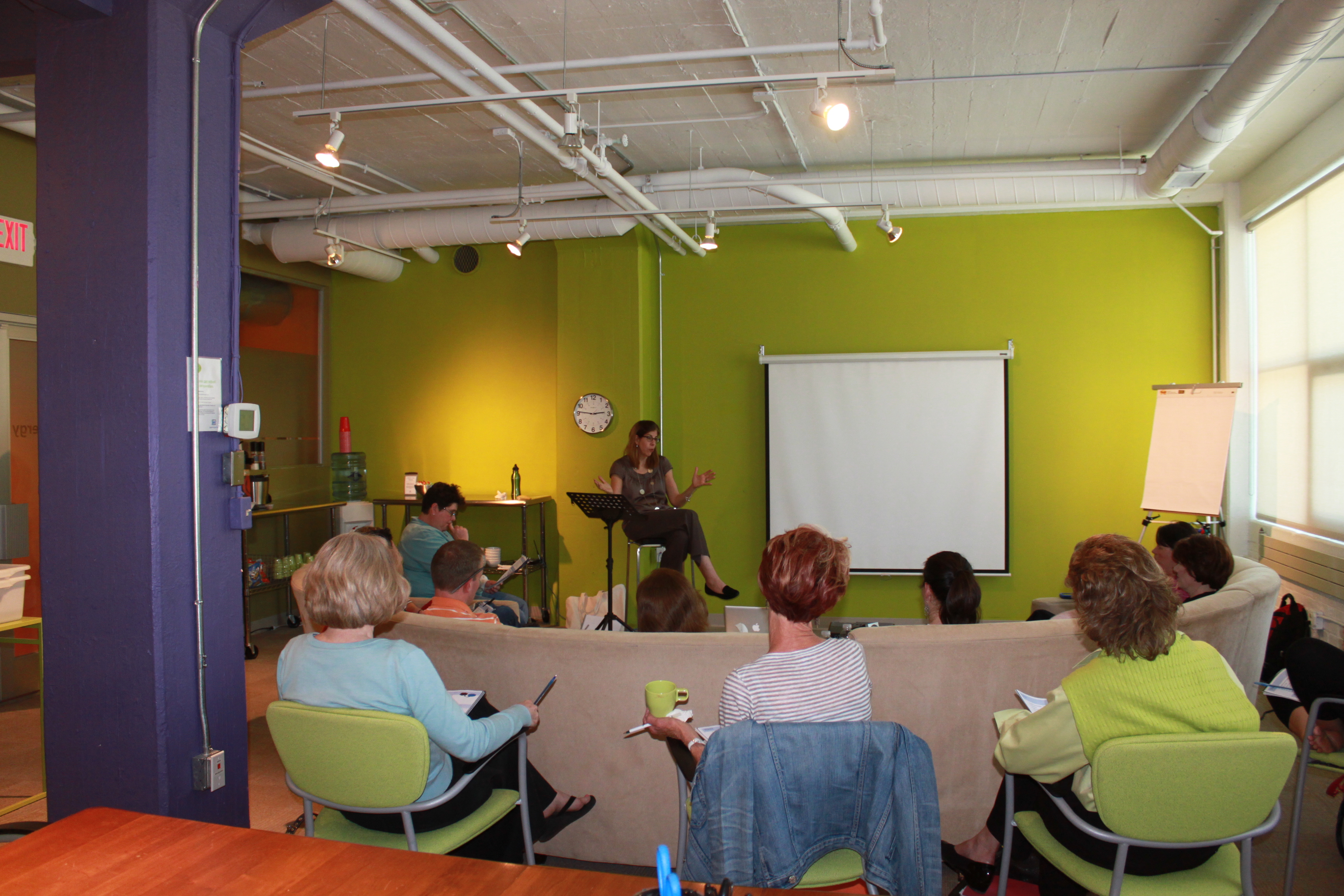
The workshop weaves blending of learnings we’ve had over the years between our critical thinking class, our four years of experience with TED and TEDx, our every day coaching of a wide range of speakers and our own pen-to-paper discipline of helping to write a major keynote address at least once a month. If we have a headline show right now in our toolkit of learning, this would be it.
Who needs this class?
Last week, the day after our class, I visited with a CEO of a major financial services firm. She recounted a situation where one of her top financial analysts had been meeting with their executive team for 8 weeks to review some trending data about a big part of their financial situation (I wish I could tell you what part but clearly it was sensitive and confidential). For 8 weeks during these meetings, she said they smiled and nodded, then politely put the charts and graphs in their folders each week, pretending to understand. It wasn’t until week 9 when the analyst came to the meeting with the following metaphor: “Let me explain that this situation I’ve been trying to paint for you is like cutting off the oxygen to our respiratory system. We are literally running out of breath.” She said it wasn’t until he related it to something she understood – the critical nature of breathing – that she finally “got it.”
Albeit a few weeks late, that is a well told story. Both the CEO and the analyst would have been well served to understand the power that a simple metaphor can bring – and how and when to use them. They also would have been well served to be able to coach each other on other effective storytelling tools – bottomlining, changing a point of view and a clear, concise message to list a few.
If you are having a hard time getting your critical messages across and evoking the behavior you seek to change, may we suggest a little dose of storytelling may just go a long way.
No Comments
The Value of ‘Values in Action’ Stories
So I guess if you don’t have company values, it would be hard to tell any “values in action” stories about them. But the reality is, we all drive our businesses on a set of SOME values – and we behave consistent with them every day. Harvesting those stories that best demonstrate how you live out your values needs to be an intentional effort, however, so they can be shared and passed around — building trust, resilience, reputation and maintaining a vision.
At the 2012 Annual Meeting of the Greater Columbus Chamber of Commerce, resource interactive Founder Nancy Kramer gave a resonating and lively speech reflecting on her company’s values and how they positioned resource for sustainable growth. We were fortunate to have the opportunity to partner with her on this talk, which, as you can tell if you watch through to the end, made it one memorable event.
Once you are done watching the talk, see if you can repeat back the stories she uses to demonstrate their values.
1 CommentThe problem with the panel.
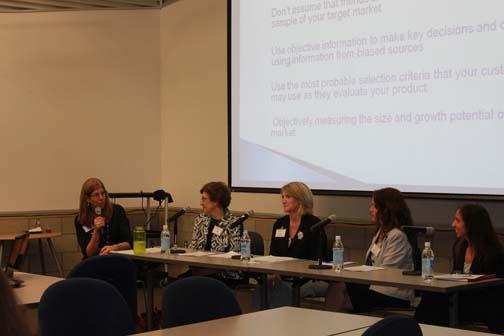
TECHColumbus Marketing Technology Panel. September 7, 2011
Let me thank the panelists from last week’s Women and Marketing event at TECHColumbus: Joan Manter, Nancy Bohman, Amy Marshall and Padma Sastry. I won’t repeat the content of the panel discussion since Nancy has a wonderful recap on her blog.
But what I do want to explore for a moment is the notion of the panel as a presentation format.
Yes, it may seem hypocritical that I’m in the photo above moderating last week’s panel and now want to question its veracity.
The reality is when I accepted the invitation, I insisted that we all gather to map out a ‘panel plan.’ And indeed, I made good on my promise and helped them wrestled a narrow topic presented in the form of five thought-provoking questions that each of us would answer. While unstated to the group, my goals in facilitating this plan were:
a. Do not have any replicating content, i.e., we each need to say something worthwhile and different;
b. Find a quality example (story, anecdote) to illuminate the ‘answers to the questions,’ i.e., give what we say a fighting chance to be remembered;
c. End on time, i.e. if we are remembered for anything, don’t make people blame us for being late to work.
So, interestingly enough, I believe the general goals from TECHColumbus in having the panel were to:
a. explore a topic that would attract an interesting group of women
b. showcase some industry experts on their turf
c. facilitate networking
All really noble goals.
But therein lies the problem with the panel, in general. It is not designed with the very broad audience in mind. At least the audience as a person listening to content. Trying to decide what is important. Who is credible. What they should take back to their desks and repeat to their colleagues. In between three cups of morning coffee. Rather, it is designed with the audience as a person who wants to network and be seen.
I visited Wikipedia a while ago on a whim looking for insight. My hypotheses was correct (for once). The “panel” was created as a listening tool, not a talking one. As in panel of judges, listening to a case.
You can see from Wikipedia’s list of purposes that a panel serves, none of them center on inviting a group of people who don’t know each other to sit together and talk to others who are there to listen. It is usually the other way around.
I asked someone at our local discussion forum which I admire greatly, Columbus Metropolitan Club, once, why do you have panels? And his candid response was: it helps to drive a crowd. If there are experts on the panel with whom people can affiliate, then there will be attendance. Fair enough.
But I’ll say it out loud. As an presentation format, I’m not a big fan of the panel. Tough for panelists to get connected, coordinated and in a good flow; tough for the audience to follow, comprehend and be impacted.
As a tool for resonating an idea, creating buzz, telling a true story, transferring knowledge or even evoking one emotion, don’t look to the panel.
As a tool to market your organization, gain some awareness, or as a vehicle for networking, sign it up.
No CommentsHow was your summer?
In our Influential Storytelling class at ar.tic.u.la.tion, we apply critical thinking methodologies to help properly frame a story. So on our summer family vacation a week ago, I thought I’d test the logic with my 7 year old daughter. What better story to practice than “what I did this summer,” knowing she’d be quizzed upon returning to school in a few days.
We found some post it notes at our cabin (lucky us) and brainstormed every memorable summer moment. After coming up with 40 points, I suggested we try to group them in 3 themes. We came up with four different grouping options:
One set were grouped by who participated in the moments with her and her brother – us, her sitter or others.
Another group was where they did them- at home, in town, or out of town.
A third was by old things, new things and things to repeat.
The last was by activity type – sitting down, standing up or in a pool!
Before you claim I’m a horrible parent for inflicting such a rigorous overlay to my daughter’s outstanding summer, she called uncle and stopped it as it was “boring.” And it was.
We hadn’t gotten to how to weave in the great visual support for any example – such as of learning to play tee ball, learning about Cleopatra in Cincinnati, building a train with her brother in the basement art space, or watching movies outdoors at the local park. For a seven year old, the fun was in the examples, not the story structure. Fair enough for a girl still on vacation.
The point is that she won’t have time or space to report all 40 activities when she answers the question. Ideally, she’d have a great narrative rooted in three general groups that revealed a supporting example- and illustrated succinctly why her summer was so awesome. Of course I don’t expect her (yet) to understand this, but by the time our official Storytelling Class closes each time, our clients certainly should.
So, tell me, how was your summer?
No CommentsYou sure you got the right analogy?
Last week during one of our Influential Storytelling trainings, a participant was proud of herself for using an analogy to get a point across to the COO of her company. It was the week the Mavericks beat the Heat, and if you aren’t into sports, that meant that the basketball season was over and LeBron lost.
Just so happens that her COO wasn’t into basketball either. “Though everyone else at the presentation was,” she claimed. “But I guess next time we need to use an example from Glee,” she admitted.
So the COO loved Glee but she used LeBron. Ooops.
The solution is easy.
Make sure you know thy audience. And really, the most important person in the audience. The one that is the decision maker.
And while she reported that he did “get it” – it did have some “rocky resonance” as I say. Sure, they may ultimately find the light but there were some clouds that could have been avoided.
So which ones do you use?
Well, first, stick with topics that you know the whole audience can associate. Homebuilding, high school, babies, food/cooking, learning to walk, driving, mother nature, NASA, checkers, medicine, Scrabble, colors, chocolate, heating/cooling, hiking, and I could go on — are all to which everyone can relate.
In the next category, I’d consider sports, movies, TV shows and books. But be careful, as evidenced by this list of the most popular movies. You might be surprised that your favorite Eastern Promises or Roshomon probably won’t be on top. Or LeBron, in more ways than one.
(Editor’s Note: This post marks my return from a break I took in June. Something had to give in the skyscraper-full list of things on my plate and in my life. Happy to be here again.)
No Comments