


Bullets are for guns.
I was at a meeting recently with a local township official, and when I asked about what highlights we should know about his community, he left the room. He quickly and enthusiastically returned with a huge power point deck titled “State of the Township.” All I could see was page after page of bullet points.
Knowing I wasn’t interested in the detail of how their road kill eradication was going (presuming it was one of the hundreds of points), I just simply asked: ‘Can you tell me the top 3 things we should know about your township?’
He hesitated. And then said, “Well, we really have 15 great points, I’m not sure which 3 to pick. Maybe the schools? Maybe our ranking as a healthy community? I’m not sure, I’ll have to ask around and see what other messages may resonate.”
Bang bang. His message died right there. A missed opportunity. And in some essence, an unveiling of his lack of clear vision and leadership for his community.
So on occasion, I curse the slide, as it allows people to avoid telling a story. But in this case, and more frequently, I’m blaming the bullet point.
A thousand good ideas have a place in your presentation or message when they are tightly grouped, edited and organized. But when ideas simply get translated into bullets, it shoots unnecessary holes in what should be a memorable, repeatable message and story.
No CommentsConvert the conversation to a presentation
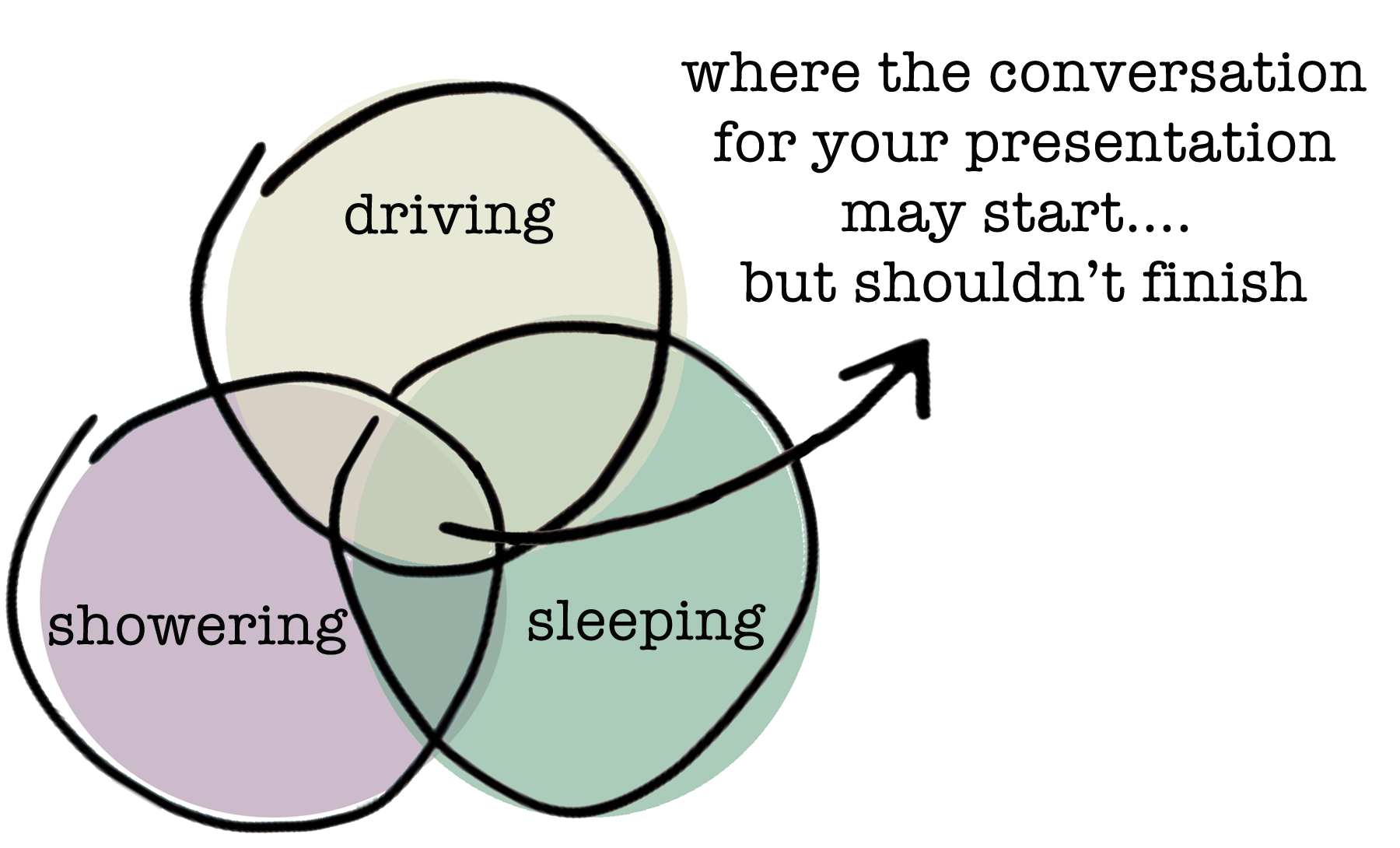
Every conversation we have is with ourselves. And on occasion it involves someone else.
Every time I repeat this quote, I get a good chuckle out of my audience. It’s the nervous kind, that says, uh, you are probably talking about me.
Last week when I was teaching a class of MBA students at the OSU Fisher College of Business on how to develop their signature stories as they enter the workforce, one of them got up and started giving her talk.
But it was really a conversation she was having with herself. It just happened to be in front of her 60 peers and me.
This month’s tip is one we take for granted: Convert the conversation to a presentation.
I see this all the time in my public speaking and presentation training, and not just with students. An executive will forget that they have a specific message to deliver and they just start rambling. And what they are really rambling off is that conversation they’ve been having – most likely with themselves. You know this pain.
So, are your presentations for your audience or yourself? Are they thoughtfully planned stories with which your audience can relate or… did they just get crafted from a dream, a book, a meeting or even disaster that happened to you recently?
Make sure when you draft your talk or presentation, it starts not with “what do I want to share today,” but rather, “what will my audience care to hear?”
And that’s when you become a convert. Your audience will be one too – a fan of your talk and your message.
No CommentsTalk Back: “What If” conference
Talk Back is an occasional review of talks we’ve attended or heard.
Yesterday, it was a delight to attend the first “What If” conference at the OSU Fisher College of Business. It was a showcase of successful entrepreneurs and their various approaches to innovation. Each person was given 20-30 minutes to present. To keep it light, I’ve given each of them an appropriate award, helping to highlight their most memorable speaking attribute.
Before I dig into my list, I was reminded of my favorite excuse TO prepare for a talk: if you do a great job, we remember what you said. If you don’t, we remember why we don’t.
The best smack down of the topic conference: Hands down goes to Kelly Mooney, President and CXO of Resource Interactive. She designed her talk around one simple innovation that her firm had developed; not her philosophy in innovation, but a practical application to their commitment to it. As the conference title suggests, the talks were supposed to help understand what happens when you say “What if..” we could mix that idea with that other concept? Or achieve those results? What would our innovation look like if we allowed ourselves those questions? Kelly’s slides were clear (although I’m still very hesitant to endorse screen shots of web pages – in this case they were not meant to be read so it worked), designed around the theme and her talk was tight. She had to keep a good pace because the conference was running late (more on that later), but not too fast for her to abandon her confident but conversational style.
The best TED talk: Peter Thum from Ethos Water. Why? Because Thum is a TEDster and given a TED talk before. The What If? conference in one of its promotional pieces, actually suggested that the talks were in the style of TED. As a TEDx organizer, this is a style I’m intimately familiar with. He had clear command of his topic (never once looked back to a slide), had slides that were image-rich (no words or few), had a friendly and easy pace to follow, projected well, sequenced his story for easy following and didn’t drone on forever. All things you learn by giving a TED talk. If you want to achieve that, just watch a TED talk every day for the next two years (there are that many).
The best verbal style: Sherri Geldin, Director of the Wexner Center for the Arts. I have long thought (and have told her as much) that she’s got a terrific oratorial style. Exceptionally confident, very well paced – you never ever hear her rush – and enough graduate words that give her credibility with the high art crowd. Now, I say verbal style because she’s got one barrier to her having an overall speaking style – she won’t talk without a podium. As such, most of us couldn’t see her because the talks were designed to be integrated with the audience and the podium was hidden to the side. Word has it she didn’t spend a lot of time preparing her remarks – barely would have known it. She can amply think on her feet, hopefully she’ll let her feet move when she talks in the future.
The best story: I may be partial, but Martin Keen’s journey from being a sailing student at OSU (seriously?) to being one of the leading designers and manufacturers of outdoor footwear, you know the ones bearing his name, was really inspiring. I loved his imagery that supported his talk even if his delivery wasn’t the most outstanding. He did a great job opening and relating to the audience, especially sine he hadn’t been back on campus for 21 years. Indeed, he put the conference in a bit of a scheduling connundrum with his length. I know It’s hard to stop someone that hasn’t been back on campus since they graduated 21 years ago and has since built an internationally known brand. It’s a note to self for the organizers: clear expectations up front and use the hook the minute they go over. I do wonder how many students were wearing his shoes in the recent flashmob.
The most memorable shirt: No other contender in this category except for Bruce Lavash from P&G who wore a Hawaiian fashion. When you have 30 patents to your name you are allowed! I’ll be sort of tough here and say he showed a bit of unpreparedness with some horrible dry mouth about 3 minutes in — a true sign of nervousness. He was energetic and passionate, but the only thing that grabbed me at the top of his talk was the shirt so I excused myself to use the restroom and return a call. A good lesson in audience engagement – get to the point or you’ll lose them. As a result of leaving for a bit, I also missed the founder of Wikipedia but the buzz in the room was that he was engaging and interesting.
Most sincere: Jeni Britton, Jeni’s Ice Creams. She told me after that she didn’t want to do it since she didn’t have much time to prepare. Barely showed. She admitted mid-talk that she was used to having her kitchen in front of her when she talked (or rather, cooked) and did exhibit a little nervousness by looking at the screen to make sure the audience looked there too. And her set-up was hard to beat: she got to end her talk by inviting everyone to sample two flavors of her exotic ice cream. She certainly fooled us if she wasn’t prepared as we all enjoyed a scoop.