


Three times makes it a trend
They say once is an event, twice is a coincidence and three times is a trend.
As we organize the third TEDxColumbus event, we’re definitely feeling the trend. Consider our first year when no one knew what TED or TEDx was. I had to explain, clarify, demonstrate and explain some more. Last year, we had some awareness but still needed to prove we could do it again. And this year, we’re now managing people’s interest, excitement, investments and involvement.
But more importantly, we’re helping with three other events that are by-products of this trend.
Next week, a statewide STEM conference will take place where their three “keynote” speakers will deliver 18- minute TED-like talks.
The following week, I’m giving a talk at CityWorksXpo, a national conference on small cities. The organizers wanted to share the essence of TEDx with the cities that had not yet embraced one. While TED doesn’t like to promote TEDx in the traditional way, I’m happy to provide some front-row insight and outcomes to what a TEDx might inspire within a city.
The next week, a major company in town is having a day-long marketing summit with their 200 internal marketing professionals and 12 ad agencies. Instead of having the agencies present creative work, they turned to me to curate (that means concept, recruit, select and coach) a morning slate of TED-like speakers centered around a compelling, futuristic idea that will ‘wake up’ their brains to where their industry is headed.
And then lastly, our main event on 11.11. We announced the speakers this week and are humbled and honored to be working with such a dedicated, passionate group. We’re expecting 500-600 to attend a full day “Moment in Time” featuring 18 speakers. That’s definitely a few steps away from our 5-hour, 8-speaker evening event the first year with just 300 in attendance.
No CommentsThe problem with the panel.
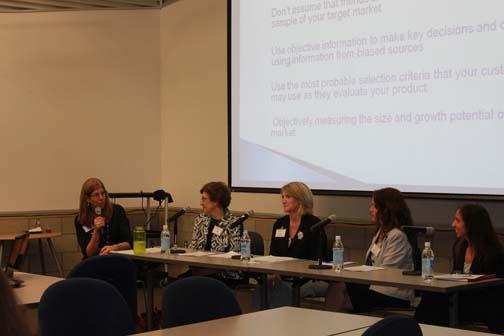
TECHColumbus Marketing Technology Panel. September 7, 2011
Let me thank the panelists from last week’s Women and Marketing event at TECHColumbus: Joan Manter, Nancy Bohman, Amy Marshall and Padma Sastry. I won’t repeat the content of the panel discussion since Nancy has a wonderful recap on her blog.
But what I do want to explore for a moment is the notion of the panel as a presentation format.
Yes, it may seem hypocritical that I’m in the photo above moderating last week’s panel and now want to question its veracity.
The reality is when I accepted the invitation, I insisted that we all gather to map out a ‘panel plan.’ And indeed, I made good on my promise and helped them wrestled a narrow topic presented in the form of five thought-provoking questions that each of us would answer. While unstated to the group, my goals in facilitating this plan were:
a. Do not have any replicating content, i.e., we each need to say something worthwhile and different;
b. Find a quality example (story, anecdote) to illuminate the ‘answers to the questions,’ i.e., give what we say a fighting chance to be remembered;
c. End on time, i.e. if we are remembered for anything, don’t make people blame us for being late to work.
So, interestingly enough, I believe the general goals from TECHColumbus in having the panel were to:
a. explore a topic that would attract an interesting group of women
b. showcase some industry experts on their turf
c. facilitate networking
All really noble goals.
But therein lies the problem with the panel, in general. It is not designed with the very broad audience in mind. At least the audience as a person listening to content. Trying to decide what is important. Who is credible. What they should take back to their desks and repeat to their colleagues. In between three cups of morning coffee. Rather, it is designed with the audience as a person who wants to network and be seen.
I visited Wikipedia a while ago on a whim looking for insight. My hypotheses was correct (for once). The “panel” was created as a listening tool, not a talking one. As in panel of judges, listening to a case.
You can see from Wikipedia’s list of purposes that a panel serves, none of them center on inviting a group of people who don’t know each other to sit together and talk to others who are there to listen. It is usually the other way around.
I asked someone at our local discussion forum which I admire greatly, Columbus Metropolitan Club, once, why do you have panels? And his candid response was: it helps to drive a crowd. If there are experts on the panel with whom people can affiliate, then there will be attendance. Fair enough.
But I’ll say it out loud. As an presentation format, I’m not a big fan of the panel. Tough for panelists to get connected, coordinated and in a good flow; tough for the audience to follow, comprehend and be impacted.
As a tool for resonating an idea, creating buzz, telling a true story, transferring knowledge or even evoking one emotion, don’t look to the panel.
As a tool to market your organization, gain some awareness, or as a vehicle for networking, sign it up.
No CommentsStale corporate events, no more!
A year ago TED unveiled a new corporate program where “private” TEDx licenses could enable corporations to host their own internal TEDx events. The guidelines are similar to a regular TEDx event with two primary caveats- only employees can attend the live event and the videos cannot be posted to a public site.
A few weeks ago a client approached us with the desire to use this model for an annual “Marketing Summit” for their 250 marketing associates plus their dozen or so ad and PR agencies with which they do business. The goal from the last four years was to have them report to each other on strategic progress plus traditional motivation (with one large keynote from an expensive speaker), but lately, they have a desire to ignite some new thinking and in a new way.
Since they want to offer some small honorariums and potentially talk about their own brands (a big no-no at a TED event), we’re going with the “TEDxLike” model. To all my friends at TED, don’t worry, we won’t call it or promote it as such. But it sends an interesting message to those who are following the TED trend. The ‘construct’ works. Show a number of provocative talks in a variety of topics in a rapid fire sequence to re-ignite creativity and generate new approaches.
So they’ve asked us to organize the majority of the day for them with anywhere from 8-12 speakers giving 18 minute talks on riveting ideas facing the future of their particular industry. Long breaks, lots of fidget and hands-on activities plus time to process the brain spa that they will encounter.
The tough work begins now. While we curate the talks on a general theme, we’ve got no less than 100 branches we can climb onto. The challenge of finding the perfect mix of topics and speakers to provoke this already savvy audience is one we welcome.
This “TEDxLike” event will be one week before TEDxColumbus, which takes place on 11.11.11. Plan on us being closed after that for a week as we retreat to the real spa.
No CommentsOn Pausing.
A college professor commented that his students were giving him a wide range of feedback on his lectures.
“Some students think I’m the second coming and others think I’m a train wreck. What gives?”
Having heard him speak at a public forum and also having had many conversations with him, the answer was pretty simple.
He never really stops.
His brain is really overflowing with insight, experience, ideas and inspiration. What he’s having a hard time doing is knowing that his audience processes his words differently.
Those that think he’s terrific are enthralled with his cadence and can keep up with the ideas. They crave that pace and are energized by it.
Those that want to run out need to process ideas a bit more slowly, or maybe, even at a regular pace.
Keeping in mind we didn’t want to ruin his enthusiastic banter, I offered a solution: build a suite of tools that force you to pause or stop. Here are some for him, (and you if you have this issue), to consider using:
A. Within your outline, write the word STOP or PAUSE (pretty obvious, eh?) what might be every 3-4 minutes.
B. Take a drink of water and don’t be in a race to start talking after you have swallowed. Ease back into the thought slowly.
C. Insert points where you offer opportunities to ask questions. Toss the dialogue around the room instead of only from your voice.
D. Build in more formal discussion opportunities among the group. Invite someone to come to the chalkboard as you facilitate a brainstorm or solve a problem.
E. Intentionally invite someone to co-present with you when possible. This takes more preparation, but it does have the built in benefit of the pause.
F. Recap your thoughts in your conclusion. This will allow those in the audience who might have missed them the first time to hear them in summary.
Remember, talking without pausing is much like reading without punctuation. The brain doesn’t have the ability to process very easily, which causes your presentation to essentially be unheard.
No CommentsSo you have invited someone to talk, eh?
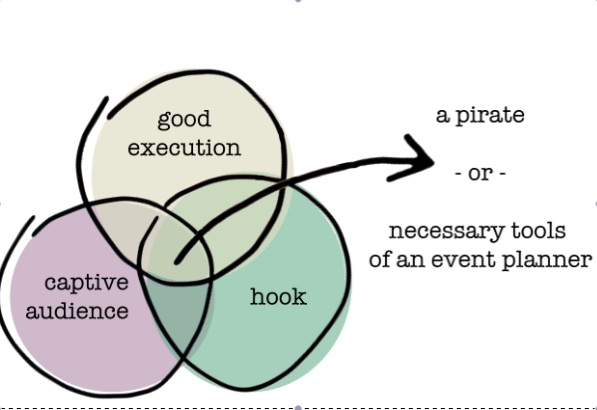
This is a note to organizers. Your role in getting a speaker ready to talk is as important as the speaker’s own preparation.
In the last post about the “What If” event, there was a fatal flaw on behalf of the organizers. I thought I’d illuminate our top three forget-me-nots that every organizer needs to know. Read More