


It’s my turn for the stage
This week I’ll be speaking at the Cityworks (X)po in Roanoke, Virginia. I was invited to speak on behalf of the TEDx global community, which now equates to 3417 events in 117 countries. Humbled, yes. Nervous, no. Since this is my “TEDx” season, the content is omnipresent in the brain, especially thanks to a great hour-long talk show with our leading local radio host.
For those of you curious about my preparation runway for a major talk, here are my 5 steps. These aren’t for everyone, but they work for me.
- Research on everything. Audience, venue, potential facts to include, reading trends, other related videos. Then let simmer.
- Work on governing idea – what’s the one thing I’ll leave them with? Develop no more than 3 key buckets of support. Brainstorm stories to resonate the buckets.
- Talk it through on my voice memos app. Transcribe it. Reverse engineer the outline to revise number two.
- Talk it through again, and make a list of visual imagery I need to resonate the stories. Research, download, buy or borrow visuals.
- Practice, syndicate and practice again. Make a note card with outline as backup.
Three times makes it a trend
They say once is an event, twice is a coincidence and three times is a trend.
As we organize the third TEDxColumbus event, we’re definitely feeling the trend. Consider our first year when no one knew what TED or TEDx was. I had to explain, clarify, demonstrate and explain some more. Last year, we had some awareness but still needed to prove we could do it again. And this year, we’re now managing people’s interest, excitement, investments and involvement.
But more importantly, we’re helping with three other events that are by-products of this trend.
Next week, a statewide STEM conference will take place where their three “keynote” speakers will deliver 18- minute TED-like talks.
The following week, I’m giving a talk at CityWorksXpo, a national conference on small cities. The organizers wanted to share the essence of TEDx with the cities that had not yet embraced one. While TED doesn’t like to promote TEDx in the traditional way, I’m happy to provide some front-row insight and outcomes to what a TEDx might inspire within a city.
The next week, a major company in town is having a day-long marketing summit with their 200 internal marketing professionals and 12 ad agencies. Instead of having the agencies present creative work, they turned to me to curate (that means concept, recruit, select and coach) a morning slate of TED-like speakers centered around a compelling, futuristic idea that will ‘wake up’ their brains to where their industry is headed.
And then lastly, our main event on 11.11. We announced the speakers this week and are humbled and honored to be working with such a dedicated, passionate group. We’re expecting 500-600 to attend a full day “Moment in Time” featuring 18 speakers. That’s definitely a few steps away from our 5-hour, 8-speaker evening event the first year with just 300 in attendance.
No CommentsOne Client’s Pathway to Resonance
Everyone has their own preparation path toward great speaking, we’re thrilled to see what changes our clients have made in theirs.
One of our clients shared with me in an email that her speaking style had improved so much after her sessions with us. I asked her for what strategies were helping HER the most. Her response:
“In the past sometimes I would just wing it. I would know the topic and would just go for it. This new way I am ready to speak on every slide, I know it cold. They could do the slides backward and I could do it. I can also tell you exactly how long my program will be.
The other thing is the stories. I told stories in the past but did not place them in certain places on purpose – for example the story at the start to get their attention and why this program is something “they” need to hear…
I have also changed how I am introduced. I never liked for people to hear all that info about me. So I am much more comfortable with a short intro that tells them why they should listent to me.
The other thing I am doing different is I used to be a walker and now I stay behind the stand and it keeps me focused and helps me to look around the room in a more controlled uniform matter.”
No CommentsThe Coaches’ Coach.
My normal client is the person or team that wants to up their game in their critical thinking, storytelling and/or presentation skills. Last week I switched hats and became a coach to the coaches.
A group of curators from TEDx programs in San Diego and Jackson Hole asked me for some help in how they should coach their speakers. So I put together my thoughts, we fired up a webinar and I woke up from an early evening nap to join in the group at 9pm (my time!). I was supposed to be teaching them tips, but instead, I learned a few things too. Here are three worth sharing:
A. When coming up with an idea to discuss, always challenge yourself to think bigger. San Diego had a speaker who was a “Horse Whisperer” but her real idea was about how we listen to and respond to things in nature. The assigned coach struggled with the “so what” when discussing the Horse idea, but got to a “aha” when we moved it one level higher.
B. Don’t assume your speakers will understand the basic tools of a great talk (besides their big idea). Included but not limited to: the opening hook, making the audience the central character of the story, give them the bottom line first and create visuals with WORDS first and then resonate them further with images. If someone hasn’t ever given a talk before, these tools will help anchor the beginning of a great framework.
C. And lastly, you can make a good speaker out of a great idea. But you cannot go the other way. As we were talking, I was reminded that it’s really okay if a speaker’s style does not outshine their idea. But even a bad idea cannot be saved by a great speaker. (And in the case of a TEDx organizer, it is a big hairy sign to not extend the invite to speak).
I’m happy to send the webinar recording to anyone that would like to see it. Just email me here.
No CommentsThe problem with the panel.
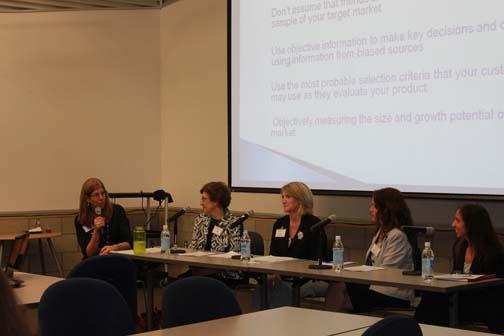
TECHColumbus Marketing Technology Panel. September 7, 2011
Let me thank the panelists from last week’s Women and Marketing event at TECHColumbus: Joan Manter, Nancy Bohman, Amy Marshall and Padma Sastry. I won’t repeat the content of the panel discussion since Nancy has a wonderful recap on her blog.
But what I do want to explore for a moment is the notion of the panel as a presentation format.
Yes, it may seem hypocritical that I’m in the photo above moderating last week’s panel and now want to question its veracity.
The reality is when I accepted the invitation, I insisted that we all gather to map out a ‘panel plan.’ And indeed, I made good on my promise and helped them wrestled a narrow topic presented in the form of five thought-provoking questions that each of us would answer. While unstated to the group, my goals in facilitating this plan were:
a. Do not have any replicating content, i.e., we each need to say something worthwhile and different;
b. Find a quality example (story, anecdote) to illuminate the ‘answers to the questions,’ i.e., give what we say a fighting chance to be remembered;
c. End on time, i.e. if we are remembered for anything, don’t make people blame us for being late to work.
So, interestingly enough, I believe the general goals from TECHColumbus in having the panel were to:
a. explore a topic that would attract an interesting group of women
b. showcase some industry experts on their turf
c. facilitate networking
All really noble goals.
But therein lies the problem with the panel, in general. It is not designed with the very broad audience in mind. At least the audience as a person listening to content. Trying to decide what is important. Who is credible. What they should take back to their desks and repeat to their colleagues. In between three cups of morning coffee. Rather, it is designed with the audience as a person who wants to network and be seen.
I visited Wikipedia a while ago on a whim looking for insight. My hypotheses was correct (for once). The “panel” was created as a listening tool, not a talking one. As in panel of judges, listening to a case.
You can see from Wikipedia’s list of purposes that a panel serves, none of them center on inviting a group of people who don’t know each other to sit together and talk to others who are there to listen. It is usually the other way around.
I asked someone at our local discussion forum which I admire greatly, Columbus Metropolitan Club, once, why do you have panels? And his candid response was: it helps to drive a crowd. If there are experts on the panel with whom people can affiliate, then there will be attendance. Fair enough.
But I’ll say it out loud. As an presentation format, I’m not a big fan of the panel. Tough for panelists to get connected, coordinated and in a good flow; tough for the audience to follow, comprehend and be impacted.
As a tool for resonating an idea, creating buzz, telling a true story, transferring knowledge or even evoking one emotion, don’t look to the panel.
As a tool to market your organization, gain some awareness, or as a vehicle for networking, sign it up.
No CommentsSyndication

For someone who has gotten rid of regular TV in the last six months, syndication has new meaning to me: the ability to have your OWN story live on.
Take for instance the most discussed, heralded and watched talk last year from TEDxColumbus by Michael Wilkos. It was a grand slam x 10. Or 30, if you count the number of times he’s been invited to re-tell it.
And last week, as a result of that talk, the reporter who covered the event for Columbus Monthly, got this story published about Michael and his insatiable love for his adopted hometown. She sent me an email and said the story most definitely was sparked from the TEDxColumbus event, and Michael’s note confirms the same. I’ll give some clarity to their otherwise very generous accolades:
— Michael had an amazing story before TEDxColumbus. He just got to tell it on a bigger more prominent stage with an audience open to new ideas and wanted to spread them.
— Michael’s passion for his topic is contagious. It came through in his talk, just as it does in this story. It is hard not to love his message (even if you aren’t from Columbus) and more importantly, his authenticity for it.
— He took this talk very seriously. The event forced him to refine, sculpt, practice, test and perfect it. As a result, it resonated. Over and over.
I love TED and TEDx for many reasons, the best of which is that it is locally becoming a credible, recognized publisher of great ideas, talks and speakers in a new media venue for the benefit of the great city I call home. We at ar.tic.u.la.tion are blessed to have the opportunity to work with great speakers like Michael to help their talks become like your favorite sitcom, one that you’ll enjoy watching over and over, but real, authentic, meaningful and full of passion. Clearly better than TV.
No CommentsSeek the question
A friend told me recently he was invited to speak to the Board of Trustees at his institution. We discussed that while he knew the topic well, he didn’t know the exact question he was answering.
“Does there need to be a question,” he asked?
So — You decide which pathway would bring him to a more resonating presentation:
#1 : Address the topic: The college’s role in commercialization. His likely talk: Broad, linear, maybe rambling, definitely programmatic.
#2 : Question focus (hypothetically): Why is our college’s commercialization role slipping against other universities and what can we do to regain our leading role, and furthermore, more revenue for the institution? His likely talk: audience attentive, result oriented, anecdote rich, recommendation specific, highly resonating.
So this month’s tip: seek the question, even if your audience hasn’t expressly stated it. You must reveal the primal issue tugging at their minds to assure they will listen. And not to mention, it helps to achieve some critical presentation goals:
– it forces you to be relevant today. (i.e. can’t use the old talk from last month)
– it assures your talk isn’t a conversation with yourself
– it gives your story (i.e. the answer) hope of being syndicated (i.e. repeated)
And if you don’t know the question, don’t give the talk! Your audience will thank you for it.
No CommentsHow was your summer?
In our Influential Storytelling class at ar.tic.u.la.tion, we apply critical thinking methodologies to help properly frame a story. So on our summer family vacation a week ago, I thought I’d test the logic with my 7 year old daughter. What better story to practice than “what I did this summer,” knowing she’d be quizzed upon returning to school in a few days.
We found some post it notes at our cabin (lucky us) and brainstormed every memorable summer moment. After coming up with 40 points, I suggested we try to group them in 3 themes. We came up with four different grouping options:
One set were grouped by who participated in the moments with her and her brother – us, her sitter or others.
Another group was where they did them- at home, in town, or out of town.
A third was by old things, new things and things to repeat.
The last was by activity type – sitting down, standing up or in a pool!
Before you claim I’m a horrible parent for inflicting such a rigorous overlay to my daughter’s outstanding summer, she called uncle and stopped it as it was “boring.” And it was.
We hadn’t gotten to how to weave in the great visual support for any example – such as of learning to play tee ball, learning about Cleopatra in Cincinnati, building a train with her brother in the basement art space, or watching movies outdoors at the local park. For a seven year old, the fun was in the examples, not the story structure. Fair enough for a girl still on vacation.
The point is that she won’t have time or space to report all 40 activities when she answers the question. Ideally, she’d have a great narrative rooted in three general groups that revealed a supporting example- and illustrated succinctly why her summer was so awesome. Of course I don’t expect her (yet) to understand this, but by the time our official Storytelling Class closes each time, our clients certainly should.
So, tell me, how was your summer?
No CommentsStale corporate events, no more!
A year ago TED unveiled a new corporate program where “private” TEDx licenses could enable corporations to host their own internal TEDx events. The guidelines are similar to a regular TEDx event with two primary caveats- only employees can attend the live event and the videos cannot be posted to a public site.
A few weeks ago a client approached us with the desire to use this model for an annual “Marketing Summit” for their 250 marketing associates plus their dozen or so ad and PR agencies with which they do business. The goal from the last four years was to have them report to each other on strategic progress plus traditional motivation (with one large keynote from an expensive speaker), but lately, they have a desire to ignite some new thinking and in a new way.
Since they want to offer some small honorariums and potentially talk about their own brands (a big no-no at a TED event), we’re going with the “TEDxLike” model. To all my friends at TED, don’t worry, we won’t call it or promote it as such. But it sends an interesting message to those who are following the TED trend. The ‘construct’ works. Show a number of provocative talks in a variety of topics in a rapid fire sequence to re-ignite creativity and generate new approaches.
So they’ve asked us to organize the majority of the day for them with anywhere from 8-12 speakers giving 18 minute talks on riveting ideas facing the future of their particular industry. Long breaks, lots of fidget and hands-on activities plus time to process the brain spa that they will encounter.
The tough work begins now. While we curate the talks on a general theme, we’ve got no less than 100 branches we can climb onto. The challenge of finding the perfect mix of topics and speakers to provoke this already savvy audience is one we welcome.
This “TEDxLike” event will be one week before TEDxColumbus, which takes place on 11.11.11. Plan on us being closed after that for a week as we retreat to the real spa.
No CommentsWhat’s your hook?
Late last year when we started paying close attention to good opening hooks, we started noting those TED talks that had particularly good ones. In this 3 minute video we produced below, we’ve spliced out 6 really notable ones, and what we consider a represenative sample of the different types of hooks you can deploy. From self-deprecating and provocative to extremely unexpected and wholly unrealistic (can you tell which one that is?), you might be inspired to try a different approach in your next talk.
See which one grab you best?
Great Opening Hooks from Articulation on Vimeo.
No Comments