


It takes both sides.

The story behind these shoes require both fact and emotion to understand them fully, just like we need the right and left to be able to walk in them (if we were so bold to try!).
Yesterday morning I delivered a keynote address on influential storytelling to 80 executives at the company DSW, headquartered in Columbus. They sell shoes and lots of them. In attempting to find the perfect metaphor to begin my talk, I made them each take off their right shoes. To a group of shoe execs, the energy in the room went from “Who is this woman and where can I get more coffee?” to “This may be fun.”
In the class and also this keynote, I always stress the importance of a balance between the objective and subjective information you should share in any talk or presentation. It is just the way our brain works. We crave to know how many people died in the plan crash before we hear one of the tragic stories. We love to hear about how sales went “through the roof” but we want to know how high with specific numbers.
So I told them to take off their right shoes and walk around a bit. I then suggested to them, after they felt the discomfort (especially the women in 5 inch wedges) that this was like giving someone data and fact only. Or better yet, selling people only the left shoe. I asked them what would happen if you only offered “lefts” in your store. One exec aptly replied “Your customers would walk out.”
Exactly. Because that’s what your audience does when you speak to only one side of the brain. Turn around and walk out.
No Comments
The Graduation Speech.
 Last week I went to my first graduation ceremony since my own in 1990. Mine was filled with caps, gowns, traditional music, flags and honorary degrees. But this one at Hampshire College, settled on a pristine and isolated swath of land 5 miles outside of Amherst, MA, embodied a different spirit. One that was authentic to their culture and personality, and full of really sophisticated curse words and inside jokes.
The “keynote” graduation speaker was a comedian, Eugene Mirman, that attended Hampshire and studied, you guess it, comedy. Remember Hampshire is one of the last hold-outs for a pure liberal arts education. Everyone graduates on time because everyone designs their course of study. I remember reading on their website when my nephew was admitted 4 years ago: “1301 Students, 1301 Majors.” Their final project is affectionately called “Div Three.” When they graduate, they are then “Div Free.”
Mirman was very funny, relevant and well, a little jarring as evidenced by his opening statement:
“Congratulations you very accomplished hipsters and self-righteous hippies.”
Geek spoiler alert: When I was single in the 90s, I would watch C-Span on my free Saturdays in June and their back-t0-back broadcast of graduation talks. I even wrote to George Will and got a copy of his address to Washington University in St. Louis (and yes, I still have the hard copy since email and websites didn’t exist then). It was my sport. So returning to a real graduation (of course, I can’t remember for the life of me who spoke at my graduation from Miami University in 1990 – shocker!) was a bit like old home week.
Mr. Mirman, while he may not have showered before he appeared at Hampshire, did meet my smell test in several categories, most importantly, his laser focus on talking to the graduates (who also probably didn’t shower, come to think of it). His talk, or series of funny one-liners, was peppered with inside jokes about how he barely got into Hampshire, and seemingly, barely got out. The f-bomb appeared about 4 times, much to the discomfort of people like my 80-year old mother but to the delight of the 22-year old capless, gownless center crowd. There was much nervous laughter, the kind you get when you tell something really true and primal.
I was a little surprised however that Mirman appeared to be the juicy meat in a dagwood-style sandwich of other talks by the favorite graduate (also very witty), the favorite teacher, the favorite staff person, the fancy board chair, the new-ish President of the college (his first graduation ceremony ever as an adult I believe- he’d never worked in Academia before), and several other students and faculty introducing other students and faculty. All of this before they brought up the 360 graduates, clad in cut-off tshirts (my nephew), pajamas, sundresses and jeans, one-by-one to the stage.
While the traditions of formal graduations may have escaped the grips of this 40-year old school, one thing did not: I doubt anyone will remember the speech. Sadly. Because he really was funny. If I could just remember another joke he told….
No CommentsWhen do you NOT need a story?
I got that question on Friday while I was training 80 HR trainers in our all-day Influential Storytelling workshop. I promptly replied with an unusual thinking-out-loud-rambling-answer that “I didn’t think so.” Then I promptly told a story why.
I was reminded when I heard this talk a few years ago when I sat in the audience craving a story to balance out the facts she was presenting. At the end, she told a story, but a wrong one (in my opinion). Her message did not resonate and in fact, it lost credibility with me.
Remember, the definition of a story is the bridge that connects what you do know and care about with what you don’t yet know and care about.
I went through several scenarios to test if there was ever a time you didn’t need one. Here’s my result:
– When you have data to share. Sure, you can use a story to help shape what the data is saying.
– When you have a procedure or how-to list. Of course, sharing a story can help someone sequence in their mind the steps you expect them to take.
– When you have an analysis or trend. It would be hard to share the trend without demonstrating one of the stories that represents the trend, right?
– When you want to introduce someone. Well, that in and of itself is a story of who they are.
– When you want to explain a rumor or challenge. It’s likely a metaphor will be needed to explain the vision to emerge from it.
I’m open, but having a hard time finding a time when a story can’t be used. It may not always be needed – but certainly, it can be desired – especially by your audience who wants to connect with your message.
No CommentsWinning the Business Competition
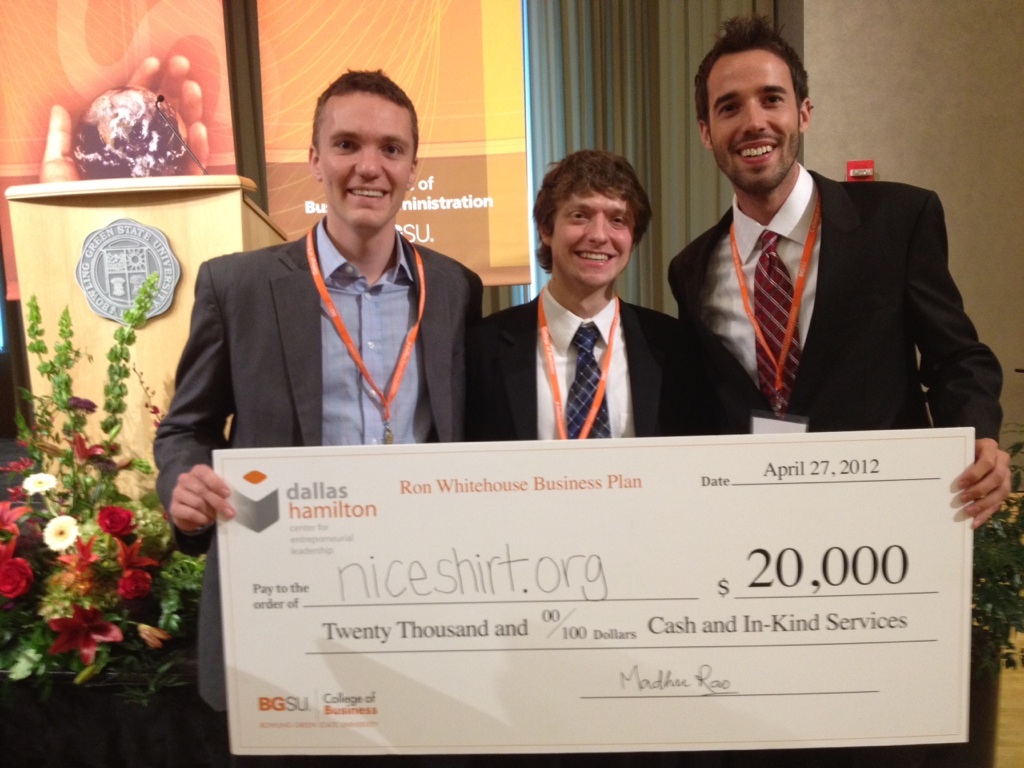
Every now and then, we get an invitation to work with a different type of client – and we love the opportunity to adapt what we do for someone new. So when Skyler Rogers, a senior at BGSU and former TEDxBGSU organizer, reached out for some help with his business competition pitch (an old concept that’s getting new energy these days), we jumped at the chance to help.
He was given 5 minutes to talk in front of an audience that would then vote for their favorite business plan. The stakes? $20,000 of cash and in-kind help for his new business called NiceShirt.org. Not bad for a guy who in a week will graduate from college.
At first, we were skeptical – how could we make a tshirt business come to life and win over the hearts of the 500 attendees who were voting on the winner? The answer became readily available to us when Skyler started sharing stories about how his shirts have helped very good causes that otherwise would have huge barriers to using apparel as a fundraising strategy.
His model was simple – if you want to sell shirts for a good cause, let us do the design, printing and distribution for you – and we’ll send you the proceeds for your cause. No more negotiating with vendors, figuring out how to distribute 5000 tshirts or what to do with $20,000 in cash (as evidenced by a case study he cited about a 16-year old kid that found himself in just that predicament).
His opponent showed a number of charts and graphs – detailing the business projections of his enterprise. Skyler told four distinct stories that demonstrated the villain (the problem) and the hero (his idea), and who would benefit (the people and their causes) and how. He didn’t show one financial graph or data chart. And as you can figure out by now -between our pride in this post and the photo above, he won.
I got a text from him after it was over, and he said “I even saw some people tearing up in the audience.” Yep, even t-shirts can make people cry. And when they cry, you’ve touched their emotions and moved them to action.
Thanks, Skyler, for working with us and congratulations! We can’t wait to hear where NiceShirt.Org takes you – or you take it!
1 Comment
Dare to fade to black
Last week, we suggested an outrageous idea to a client who was addicted
to PowerPoint (as in she had sent at least 200 pages of slides in 4
decks). While we were helping her to narrow down a presentation to 15
slides, we also suggested they use a black slide when one of the 5
presenters told a poignant and personal story. Just a simple black
slide. The response? Oh, no, we couldn’t!
So here’s our tip: Try to use one black slide. As you always want to
connect the visual (what they see) with the verbal (what you say) with
the vocal (how you say it), so by taking away an image (even your
‘master design’) on the screen and just telling a story, it will
achieve different resonation. And don’t forget! The speaker IS a
visual.
Indeed I do think some of the best presentations can paint pictures
without using any slides. But for those that are in the
mouse-wheel-world of PowerPoint decks, do give the “black slide” a
try.
On Coaching and Training
April was a wonderful month, thank you! We coached on talks that ranged
from a community keynote to major internal corporate meeting, from a
new business pitch to a business plan competition, from medical
training to a stakeholder conference welcome address. We are grateful
for the diversity of talent and projects seeking our help.
Meanwhile, we hosted our first public Influential Storytelling all-day
training and brought a dynamic lunch-and-learn version of it to
Battelle. Our upcoming public presentations will be at the SOTA
conference on May 11 and the WELD conference on June 7.
We would love to help your associates learn the value of storytelling
as well! Let us know if you’d like a preview of our class to share the
value of how stories can help advance key business opportunities.
A little TEDx – related news:
– Nominations are still open for the fall TEDxColumbus event on October
5 @ COSI, click here to read our blog for details. This year’s
theme is “The Future Revealed.”
– Be sure to visit the latest addition the the TEDxColumbus website,
FOLLOW THIS. Ever wonder what happens after TEDxColumbus? Did that idea
work? That project gain momentum? Curious what that speaker is up to
now? FOLLOW THIS answers these questions. Visit the FOLLOW THIS
section of TEDxColumbus.com.
Our Influential Storytelling Class
Last week we re-launched our Influential Storytelling class. Like all good motors, it needed a tune up, and just in time too. These 15 participants came together from 7 different organizations to get down to the business of “story.”
One of the attendees in his evaluation said:
“It is rare that one experiences something that could truly change the way they behave. I like to tell stories but often feel that I give way too much info in the beginning and never get to the point. The idea of “architecting” stories is powerful AND I plan to use it.”
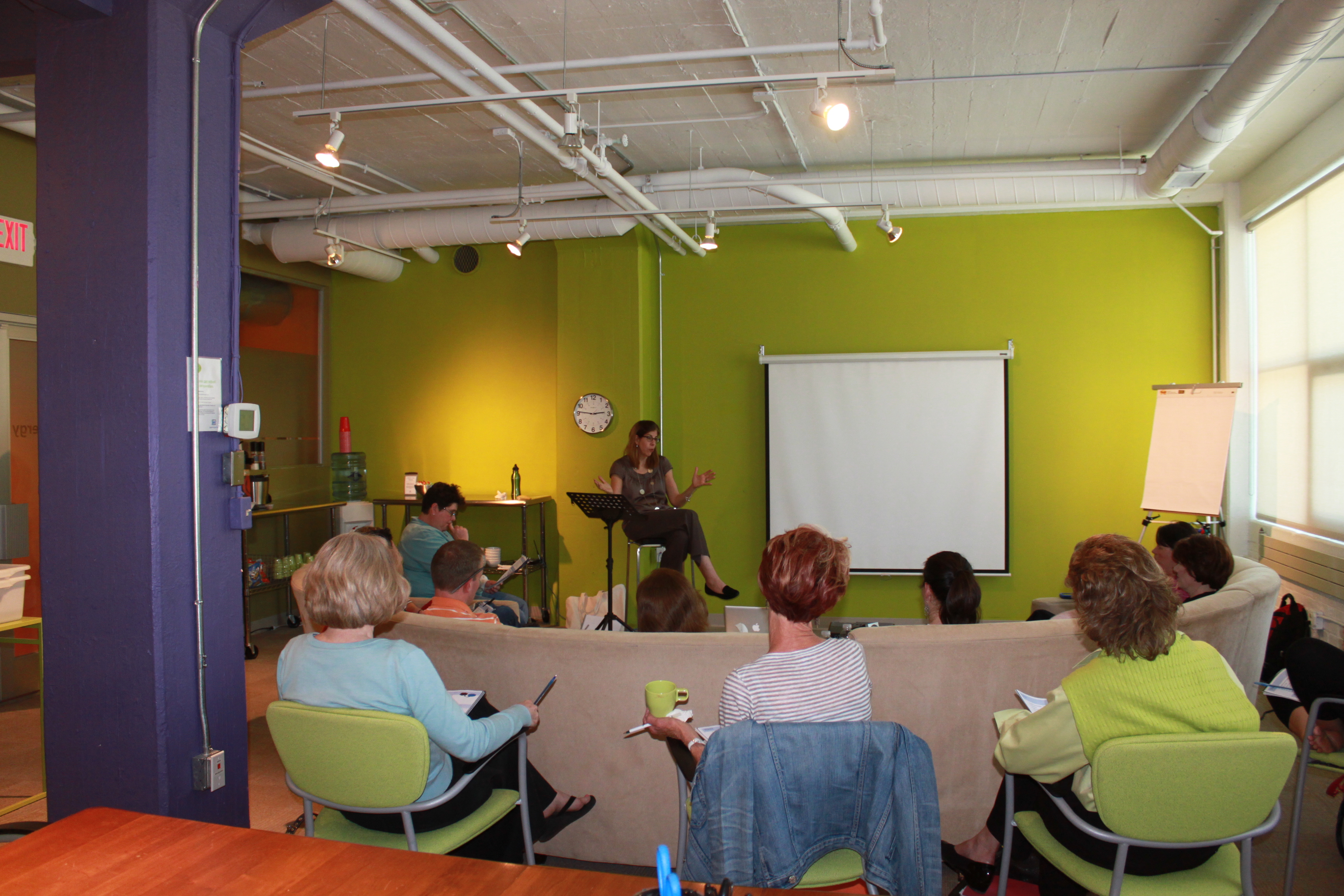
The workshop weaves blending of learnings we’ve had over the years between our critical thinking class, our four years of experience with TED and TEDx, our every day coaching of a wide range of speakers and our own pen-to-paper discipline of helping to write a major keynote address at least once a month. If we have a headline show right now in our toolkit of learning, this would be it.
Who needs this class?
Last week, the day after our class, I visited with a CEO of a major financial services firm. She recounted a situation where one of her top financial analysts had been meeting with their executive team for 8 weeks to review some trending data about a big part of their financial situation (I wish I could tell you what part but clearly it was sensitive and confidential). For 8 weeks during these meetings, she said they smiled and nodded, then politely put the charts and graphs in their folders each week, pretending to understand. It wasn’t until week 9 when the analyst came to the meeting with the following metaphor: “Let me explain that this situation I’ve been trying to paint for you is like cutting off the oxygen to our respiratory system. We are literally running out of breath.” She said it wasn’t until he related it to something she understood – the critical nature of breathing – that she finally “got it.”
Albeit a few weeks late, that is a well told story. Both the CEO and the analyst would have been well served to understand the power that a simple metaphor can bring – and how and when to use them. They also would have been well served to be able to coach each other on other effective storytelling tools – bottomlining, changing a point of view and a clear, concise message to list a few.
If you are having a hard time getting your critical messages across and evoking the behavior you seek to change, may we suggest a little dose of storytelling may just go a long way.
No Comments
The Value of ‘Values in Action’ Stories
So I guess if you don’t have company values, it would be hard to tell any “values in action” stories about them. But the reality is, we all drive our businesses on a set of SOME values – and we behave consistent with them every day. Harvesting those stories that best demonstrate how you live out your values needs to be an intentional effort, however, so they can be shared and passed around — building trust, resilience, reputation and maintaining a vision.
At the 2012 Annual Meeting of the Greater Columbus Chamber of Commerce, resource interactive Founder Nancy Kramer gave a resonating and lively speech reflecting on her company’s values and how they positioned resource for sustainable growth. We were fortunate to have the opportunity to partner with her on this talk, which, as you can tell if you watch through to the end, made it one memorable event.
Once you are done watching the talk, see if you can repeat back the stories she uses to demonstrate their values.
1 CommentGet your story on
My favorite quote from the TED Conference this year was from the (now former) head of DARPA, the defense agency that plans our strategic responses on surprise attacks, Regina Dugan. She said: “If you want to learn to fly, you have to FLY.”
It seemed so simple. But for an agency that fails all the time in its experiments, it meant so much.
I used the quote this week as I prepared to conduct a webinar on using stories in virutal relationships: if you want to build the relationship, you have to share stories. Nothing else achieves the same result. Simple, but hard.
So my tip for the month is: if you want your stories to be impactful, start telling stories.
Storytelling Workshop: Special Session
So maybe you are wondering how do I tell those impactful stories? We’ve opened up a one day workshop on Influential Storytelling on April 19 from 9am – 3pm (in Columbus) to help. It’s a small group and we’re almost at capacity, so click here if you’d like to join us. We normally only do these workshops inside corporations – we are excited to be able to offer this session for anyone that wants to attend.
A little more TEDx – related news:
– Next week on April 5, we are hosting TEDxChange, a 90 minute program being broadcast from Berlin, featuring Melinda Gates and other speakers on crticial worldwide issues. Registration is free, an optional lunch can be ordered. Click here.
– We have opened nominations for the fall TEDxColumbus event on October 5 @ COSI, click here to read our blog for details. This year’s theme is “The Future Revealed.”
– We have started a new initative called Readers’ Roundtable. Inspired by their respective TEDxColumbus talk, each session will be lead by a former TEDxColumbus speaker who chooses a book and facilities discussion. Learn more and register for an event.
– Lastly, we encourage you to watch Bryan Stevenson’s talk. His talk was among the most favored at TED this year, and with good reasons. Beyond his compelling argument, just listen to his stories.
A Closing Memorial
I will close with a little honor to my big and very special dad who passed away unexpectedly but very peacefully on March 3. For those of you that know me know what an inspiration and influence he was on my life, especially as a great orator and storyteller. I was honored to give a eulogy at his funeral, my greatest challenge I’ve ever experienced as a public speaker. Good news is that he left a litany of rich stories for me to share. May he rest in peace.
No CommentsRemembrances of the life of William W. Milligan
On March 8, 2012 I was privileged to give the hardest talk of my life – a eulogy for my father. This is an audio capture of the church service of the four remembrances with a slide show of images of him throughout his life. He died on March 3, a few hours after I got home from TEDActive 2012 in California, in his sleep peacefully after a full 88 years of living a remarkable life. I was inspired by his dense oratorial style where every word counted, his love of research to support every hypotheses or idea, and his unforgettable and memorable stories.
In order:
Patrick H. Milligan, brother
Ruth Milligan, daughter
Lydia and Will Delphia, Grandchildren