


The Graduation Speech.
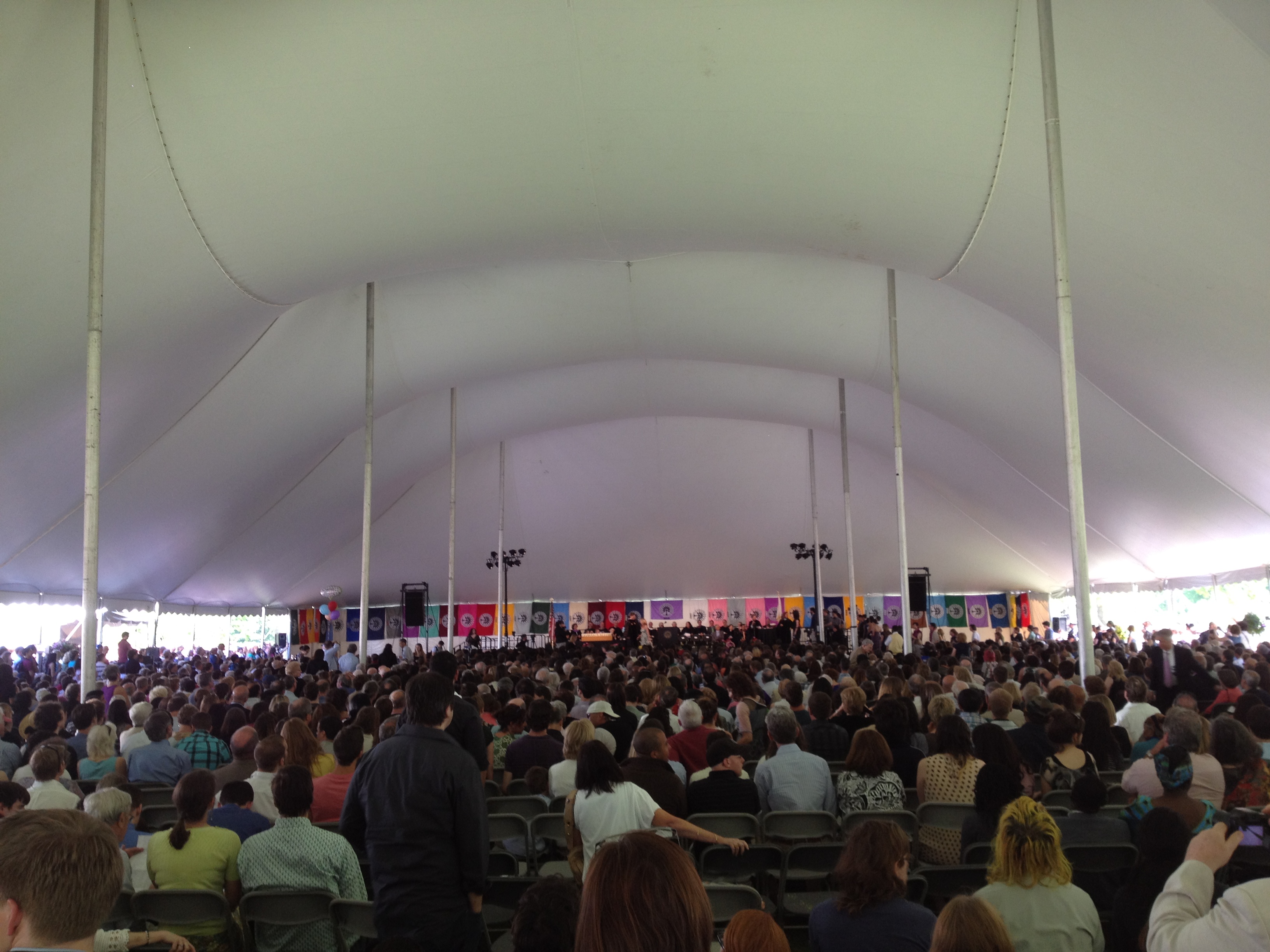 Last week I went to my first graduation ceremony since my own in 1990. Mine was filled with caps, gowns, traditional music, flags and honorary degrees. But this one at Hampshire College, settled on a pristine and isolated swath of land 5 miles outside of Amherst, MA, embodied a different spirit. One that was authentic to their culture and personality, and full of really sophisticated curse words and inside jokes.
The “keynote” graduation speaker was a comedian, Eugene Mirman, that attended Hampshire and studied, you guess it, comedy. Remember Hampshire is one of the last hold-outs for a pure liberal arts education. Everyone graduates on time because everyone designs their course of study. I remember reading on their website when my nephew was admitted 4 years ago: “1301 Students, 1301 Majors.” Their final project is affectionately called “Div Three.” When they graduate, they are then “Div Free.”
Mirman was very funny, relevant and well, a little jarring as evidenced by his opening statement:
“Congratulations you very accomplished hipsters and self-righteous hippies.”
Geek spoiler alert: When I was single in the 90s, I would watch C-Span on my free Saturdays in June and their back-t0-back broadcast of graduation talks. I even wrote to George Will and got a copy of his address to Washington University in St. Louis (and yes, I still have the hard copy since email and websites didn’t exist then). It was my sport. So returning to a real graduation (of course, I can’t remember for the life of me who spoke at my graduation from Miami University in 1990 – shocker!) was a bit like old home week.
Mr. Mirman, while he may not have showered before he appeared at Hampshire, did meet my smell test in several categories, most importantly, his laser focus on talking to the graduates (who also probably didn’t shower, come to think of it). His talk, or series of funny one-liners, was peppered with inside jokes about how he barely got into Hampshire, and seemingly, barely got out. The f-bomb appeared about 4 times, much to the discomfort of people like my 80-year old mother but to the delight of the 22-year old capless, gownless center crowd. There was much nervous laughter, the kind you get when you tell something really true and primal.
I was a little surprised however that Mirman appeared to be the juicy meat in a dagwood-style sandwich of other talks by the favorite graduate (also very witty), the favorite teacher, the favorite staff person, the fancy board chair, the new-ish President of the college (his first graduation ceremony ever as an adult I believe- he’d never worked in Academia before), and several other students and faculty introducing other students and faculty. All of this before they brought up the 360 graduates, clad in cut-off tshirts (my nephew), pajamas, sundresses and jeans, one-by-one to the stage.
While the traditions of formal graduations may have escaped the grips of this 40-year old school, one thing did not: I doubt anyone will remember the speech. Sadly. Because he really was funny. If I could just remember another joke he told….
No CommentsWhen do you NOT need a story?
I got that question on Friday while I was training 80 HR trainers in our all-day Influential Storytelling workshop. I promptly replied with an unusual thinking-out-loud-rambling-answer that “I didn’t think so.” Then I promptly told a story why.
I was reminded when I heard this talk a few years ago when I sat in the audience craving a story to balance out the facts she was presenting. At the end, she told a story, but a wrong one (in my opinion). Her message did not resonate and in fact, it lost credibility with me.
Remember, the definition of a story is the bridge that connects what you do know and care about with what you don’t yet know and care about.
I went through several scenarios to test if there was ever a time you didn’t need one. Here’s my result:
– When you have data to share. Sure, you can use a story to help shape what the data is saying.
– When you have a procedure or how-to list. Of course, sharing a story can help someone sequence in their mind the steps you expect them to take.
– When you have an analysis or trend. It would be hard to share the trend without demonstrating one of the stories that represents the trend, right?
– When you want to introduce someone. Well, that in and of itself is a story of who they are.
– When you want to explain a rumor or challenge. It’s likely a metaphor will be needed to explain the vision to emerge from it.
I’m open, but having a hard time finding a time when a story can’t be used. It may not always be needed – but certainly, it can be desired – especially by your audience who wants to connect with your message.
No CommentsWinning the Business Competition
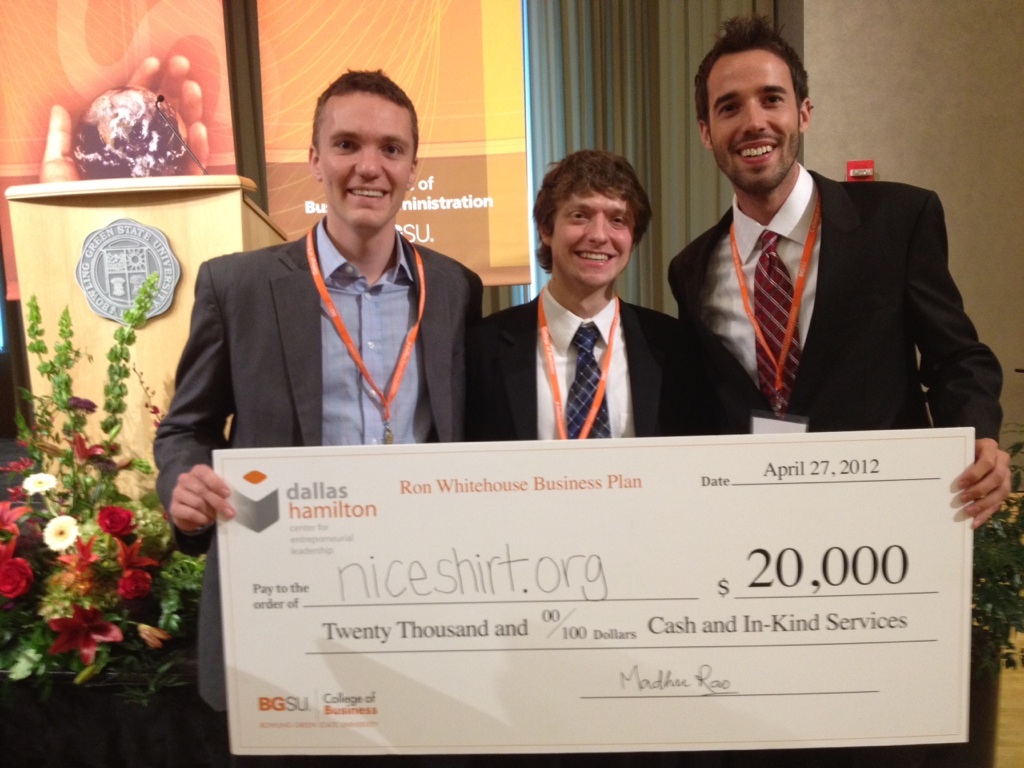
Every now and then, we get an invitation to work with a different type of client – and we love the opportunity to adapt what we do for someone new. So when Skyler Rogers, a senior at BGSU and former TEDxBGSU organizer, reached out for some help with his business competition pitch (an old concept that’s getting new energy these days), we jumped at the chance to help.
He was given 5 minutes to talk in front of an audience that would then vote for their favorite business plan. The stakes? $20,000 of cash and in-kind help for his new business called NiceShirt.org. Not bad for a guy who in a week will graduate from college.
At first, we were skeptical – how could we make a tshirt business come to life and win over the hearts of the 500 attendees who were voting on the winner? The answer became readily available to us when Skyler started sharing stories about how his shirts have helped very good causes that otherwise would have huge barriers to using apparel as a fundraising strategy.
His model was simple – if you want to sell shirts for a good cause, let us do the design, printing and distribution for you – and we’ll send you the proceeds for your cause. No more negotiating with vendors, figuring out how to distribute 5000 tshirts or what to do with $20,000 in cash (as evidenced by a case study he cited about a 16-year old kid that found himself in just that predicament).
His opponent showed a number of charts and graphs – detailing the business projections of his enterprise. Skyler told four distinct stories that demonstrated the villain (the problem) and the hero (his idea), and who would benefit (the people and their causes) and how. He didn’t show one financial graph or data chart. And as you can figure out by now -between our pride in this post and the photo above, he won.
I got a text from him after it was over, and he said “I even saw some people tearing up in the audience.” Yep, even t-shirts can make people cry. And when they cry, you’ve touched their emotions and moved them to action.
Thanks, Skyler, for working with us and congratulations! We can’t wait to hear where NiceShirt.Org takes you – or you take it!
1 Comment