


How Kit Kat led to TED, told ala Pecha Kucha.
So a few years ago I wrote this blog post on how I thought the Pecha Kucha (Japanese for Chit-Chat) was a fun format for an audience but a really tough one for a speaker. It dictates you deliver a talk with 20 slides on a timer for 20 seconds a slide.
So last summer when I was invited to give a PK talk, I told them I’d do it without slides. They said no : I had to use slides.
So I sent a black slide and asked them to play it 20 times. They said no : I had to show slide progression.

The dot that moved 20 times.
So I sent a slide that looked like this and had the dot rotate around the circle — one dot movement per each of the 20 slides. And they said yes: finally.
My motivation was that I wanted to tell a very personal story as the guidelines are pretty loose on what content you can bring forward as long as it shows your passion. I didn’t feel that slides would augment my story, in fact, I thought they would distract. And I didn’t ever want to turn my back to the audience to check if I was on the right slide (Rule #1 of public speaking) which is what happens when the slides are on a timer.
So now that I’m watching the video (posted below, don’t judge the quality!), I see that they may have had a confidence monitor (at my feet). A confidence monitor is what we call the screen facing a speaker to demonstrate the slides playing to the audience. True fact: I never saw the monitor as I am apt to look at the audience, not the floor. And it didn’t matter, since I timed my talk to be 6:40 (the time of 20 slides x 20 seconds) and just let it rip. It wasn’t until about 5 minutes in that I even remembered I had slides because I never practiced with them or needed them to prompt my story.
A good friend wrote on my Facebook page that he thought my slides were on the fritz…until the end. So watch for yourself and see how I gave a Pecha Kucha talk “without” slides. Which allowed me to focus on the thing that did matter: my passion and my story.
How I found my Kit Kat. from Articulation on Vimeo.
No Comments
Fail Better, for sure!
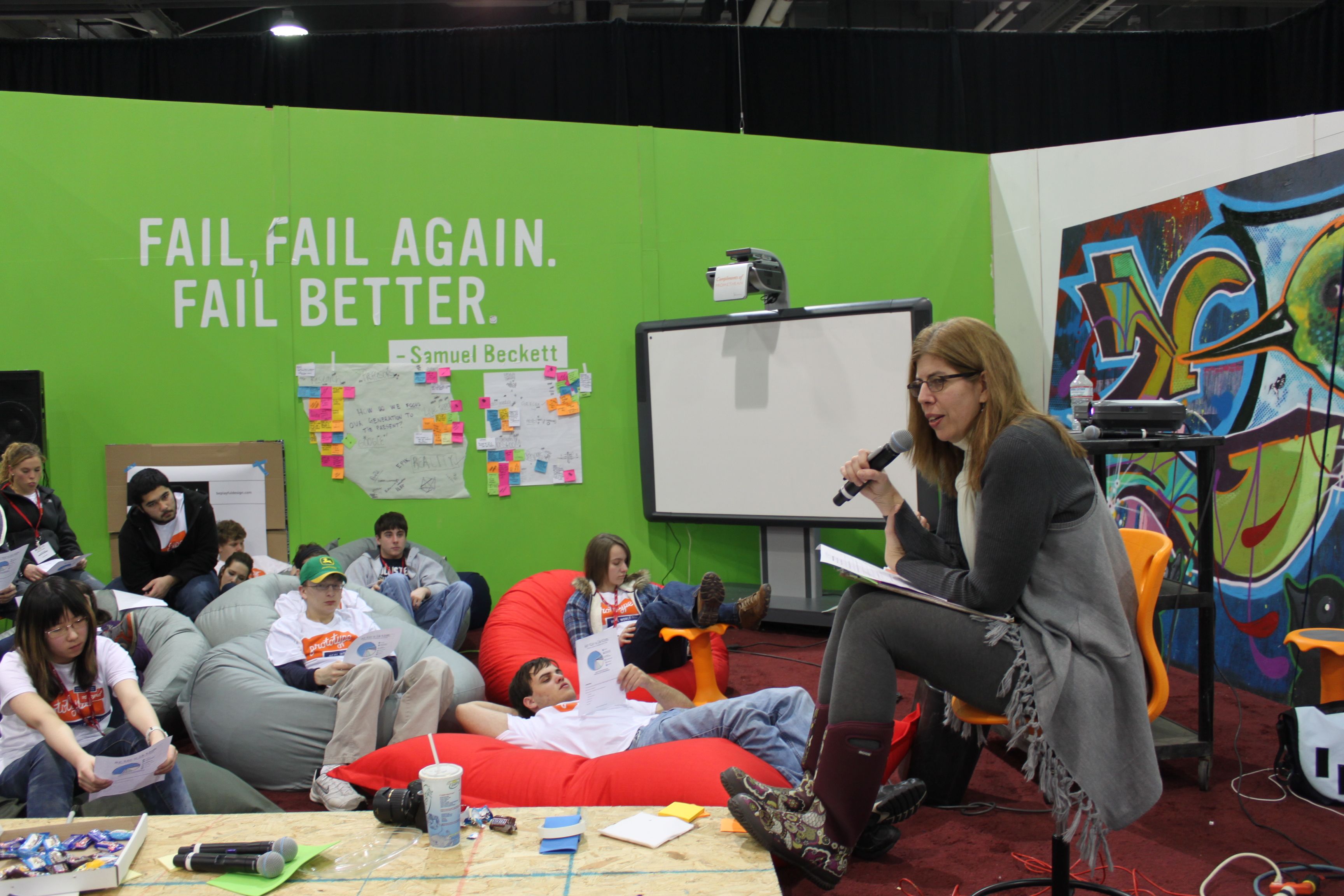 This group of junior and high school students took over a big, open, colorful studio space filled with German-designed, state-of-the-art, learning-inspired furniture created within the confines of the convention hall / trade show, and were broken down into six teams and given a challenge: design a solution to any problem you want to solve. You’ll see the mantra that hovered over them daily: Fail, Fail Again. Fail Better!
Over the course of the three days, they are lightly guided by outstanding designers and educators organized from Be Playful, an collaborative consultancy working on re-designing learning environments to be more innovative and creative. It should be noted that this “Prototype” was a sample of more sustainable endeavor Be Playful is testing.The e-tech Ohio conference where they were being hosted was a great partner in helping them incubate it – and gave otherwise sullen attendees a live, interactive glimpse of how learning can be dynamic and well, playful.
Their assignment was to come up with a 15 minute presentation to unveil both their perceived problem (half the battle, right?) and recommended solution to a sophisticated jury of professionals from the design, arts, information technology, retail planning, media and more. My role was to address the 30+ students to prepare them for their juried presentation.
At the end of my short overview of a compelling pitch, which included using the five key questions on how to build a story (any story) from Save the Cat , I was then peppered with questions. Many questions. I found them to have a beautiful naiveté that we take for granted when we’re older, more sullen and feeling like giving a presentation is more a chore than an exploration and learning.
I thought I’d share a sampling of those queries, with a summary of my answer beneath each.
Q: We have 5 great ideas, how do you expect us to come up with one?
A: Then you aren’t ready to present. The jury wants to hear one great idea with some strong proof points. If you give them five, you haven’t found the right theme or connection between the ideas — OR you haven’t killed enough of your little darlings.
Q: What happens if you have a really good idea but not a great presentation? What if is is all over the map and sloppy? Do you think we’ll still have a chance of winning?
A: You may come in second, but rarely will you win. Because someone else will likely nail both the idea and the presentation and outshine you.
Q: Why shouldn’t we introduce ourselves at the beginning of our presentation? How will the jury know who we are?
A: Earlier I advocated for a strong opening hook, one that grabbed the jury from the first minute and made them want to follow the story. If you want your opening hook to be “My name is Kate, his name is Bill and that over there is Susan” feel free. But wouldn’t it be better for them to hear your great idea and why it matters at the top — since you should always give them the most important information first? There will always be time later in the presentation to explain who you are since that matters less than the idea you are presenting – at least for the first few minutes.
Q: How do you know who should be your team spokesperson?
A: As you look around at your team I can see the anxiety of group dynamics trying to decide, who should talk? This is a part of the leadership process you should embrace in this workshop! Here’s a few non-negotiables that I’d look for in choosing your spokesperson:
– Someone that can speak with limited notes (to assure to stay on message) but not someone who has to read.
– Someone who is not nervous and speaks too fast or with too many gesticulations (a clear sign of nervousness)
– Someone who is not afraid to engage with the jurors in a conversation – ie look them in the eye, talk to them one-on-one
Q: Then what should the rest of the team do if we aren’t speaking?
A: Have you ever seen a spouse on stage next to their politician wife or husband? They are supportive. They look engaged. They try to connect with the audience as well. The completeness of your team relies on your being present, too. Even if you aren’t uttering a word. Conversely, you can be the Q & A team – providing subject matter expertise or supporting your spokesperson to give him/her a break.
Q: What is better, a presentation with or without visuals?
A; If you can’t tell the story of your idea without visuals, then you don’t need any — yet. Visuals are used to SUPPORT your story / pitch – not to make it for you. The more compelling the story, the less visuals you need. I challenge the efficacy of slides in the Pecha Kucha model but know it’s helpful when a specially designed visual of a complex idea can be real aid in the oral delivery.
Q: How do we interact with the judges? They want us to “get to know them” but I’m not sure what to do with information we find out.
A: Wouldn’t it be helpful to know if all of your judges had PhDs in electrical engineering when your idea you are presenting has to do with dance therapy? Perhaps you’ll need to explain some more baseline information than if they were all advanced degree holders in dance therapy. It’s the first place you start in preparing your presentation: know they audience. And during the presentation, if you can call out someone that may have a relevance to your topic, which is one of the five rules of a good story: it’s relevant to me. That leaves only 4 more to go!
Q: How much time should we take for the presentation vs. allow for judges questions?
A: Since you were given 15 minutes total, factor in that you want them to be engaged — and be encouraged to ask questions. So make the pitch for half the time. But then again, if you have a complex idea to share, it may require most of the time. I’d suggest that, whatever you do, make sure you stop at 15. It’s the 16th minute that will cause you to be disqualified if all other teams stick to the basic rules. That’s when you know you have failed. Next time, fail better!